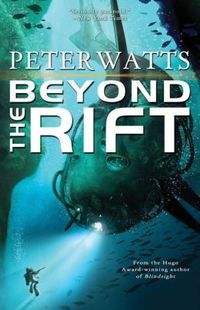
This complex SF series of stories is a challenging read, starting with a being from elsewhere crashlanding in Antarctica and, as in the Alien films, using up any life it meets. This being needs a living host and tries to control a person to get it to safety and wait until it can get off the planet again. BEYOND THE RIFT describes the events from the visitor's point of view, and its contempt for the native beings.
The next story tells of deep space explorers who come across a red dwarf star surrounded by a Dyson sphere (though that term is not used) made out of thin living tissue which soaks up all the energy emitted by the small star. The membrane is considered to have nerve cells and some kind of intelligence. Given how little regard the explorers have for other forms of intelligence however, is this a good thing?
A common theme is biological advances or differences, so that a mother carries around a tube of liquid skin instead of sticking plasters for her child's cuts, while neuroimplants enable a game player to touch the game world. Stationed in a submerged habitat down in the ocean rift, divers make observations of always-hungry giant fish which are attracted to light.
Author Peter Watts writes about himself and his works at the end, telling us that most critics find his material dark, depressing and dystopian. He begs to disagree and does come across as having a sense of humour. Unfortunately he declares that a ravaged environment is the only possible outcome for our future at this time, and upon this world he has to build his stories. A Canadian, he describes the summary arrest of over a thousand environmental protestors during the G20 summit, from which few charges were brought and no convictions resulted. To understand the background from which Watts writes is perhaps to understand the stories better, and to see allegory in the first two stories described above - colonists from across the sea meeting native peoples in Earth's past, with no guarantee that the future will hold better attitudes. BEYOND THE RIFT is certainly food for thought.
No excerpt available.











 © 2003-2026