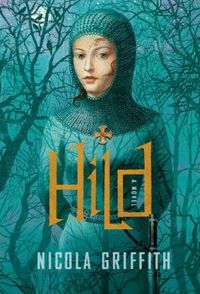
HILD is a little girl in Northumbria, aged three. Her father the prince dies and she and her friend Cian, aged seven, and older sister Hereswith are not safe, for battle approaches. The various kingdoms of Britain fight among themselves at this time and women need protection. Hild's mother is afraid that her husband's cousins will not protect the children, so she travels home to her brother King Edwin with them.
The king's court moves around the land as no one place could keep five hundred people supplied with food. The great walled city of York is one stop, fortified against winter war. Franks and Anglisc peoples are to be found, as well as Irish and British, Pictish and the isle of Vannin. Yule brings feasting and more talk of war. A few years later the sharp Hild is shown around a ruined Roman villa, with its own piped water supply, hypocaust and mosaics - all exotic and ancient to her eyes. By observing nature and listening, Hild can tell that the winter is going to be mild, or the spring has come early, or that enemies have sailed around the coast to take a castle while the king is absent. She is thought to be a seer, and battles are joined on her advice, though the new Christian religion disapproves of prophecies - especially by women.
Some words are adapted from the early forms of English used and may confuse those not used to seeing them; aethling, reeve and thegn are terms of status at the time. The trees are appropriately elm, hornbeam, birch and the newly imported beech, ash, oak, holly, crabapple. Details of food, drink and clothing are carefully presented, while furs and amber are traded from the Baltic. HILD is a very good read for anyone wishing to learn about these turbulent times, and about the life of people in the British Isles after the Romans had left the shores. Nicola Griffith uses the story of one girl to explain the cultures and histories of the scattered kingdoms and the daily lives of women at that time.
HILD is not really a tale for young adults although it would help anyone studying the period. This is a complex adventure and a fascinating read.
A brilliant, lush, sweeping historical novel about the rise
of the most powerful woman of the Middle Ages: Hild
Hild is born into a world in transition. In seventh-century
Britain, small kingdoms are merging, usually violently. A
new religion is coming ashore; the old gods’ priests are
worrying. Edwin of Northumbria plots to become overking of
the Angles, ruthlessly using every tool at his disposal:
blood, bribery, belief.
Hild is the king’s youngest niece. She has the powerful
curiosity of a bright child, a will of adamant, and a way of
seeing the world—of studying nature, of matching cause with
effect, of observing human nature and predicting what will
happen next—that can seem uncanny, even supernatural, to
those around her. She establishes herself as the king’s
seer. And she is indispensable—until she should ever lead
the king astray. The stakes are life and death: for Hild,
her family, her loved ones, and the increasing numbers who
seek the protection of the strange girl who can read the
world and see the future.
Hild is a young woman at the heart of the violence,
subtlety, and mysticism of the early medieval age—all of it
brilliantly and accurately evoked by Nicola Griffith’s
luminous prose. Recalling such feats of historical fiction
as Hilary Mantel’s Wolf Hall and Sigrid Undset’s Kristin
Lavransdatter, Hild brings a beautiful, brutal world—and one
of its most fascinating, pivotal figures, the girl who would
become St. Hilda of Whitby—to vivid, absorbing life.
EXCERPT
The child’s world changed late one afternoon, though
she didn’t know it. She lay at the edge of the hazel
coppice, one cheek pressed to
the moss that smelt of worm cast and the last of the sun,
listening: to the wind in the elms, rushing away from the
day, to the jackdaws changing their calls from “Outward!
Outward!” to “Home now! Home!,” to the rustle of the last
frightened shrews scuttling under the layers of leaf fall
before the owls began their hunt. From far away came the
indignant honking of geese as the goosegirl herded them back
inside the wattle fence, and the child knew, in the wordless
way that three-year-olds reckon time, that soon Onnen would
come and find her and Cian and hurry them back.
Onnen, some leftwise cousin of Ceredig king, always hurried,
but the child, Hild, did not. She liked the rhythm of her
days: time alone (Cian didn’t count) and time by the fire
listening to the murmur of British and Anglisc and even
Irish. She liked time at the edges of things—the edge of the
crowd, the edge of the pool, the edge of the wood—where all
must pass but none quite belonged.
The jackdaw cries faded. The geese quieted. The wind cooled.
She sat up. “Cian?”
Cian, sitting cross-legged as a seven-year-old could and
Hild as yet could not, looked up from the hazel switch he
was stripping.
“Where’s Onnen?”
He swished his stick. “I shall hit a tree, as the Gododdin
once swung at the wicked Bryneich.” But the elms’ sough and
sigh was becoming a low roar in the rush of early evening,
and she didn’t care about wicked war bands, defeated in the
long ago by her Anglisc forefathers.
“I want Onnen.”
“She’ll be along. Or perhaps I shall be the hero Morei,
firing the furze, dying with red light flaring on the enamel
of my armour, the rim of my shield.”
“I want Hereswith!” If she couldn’t have Onnen, she would
have her sister.
“I could make a sword for you, too. You shall be Branwen.”
“I don’t want a sword. I want Onnen. I want Hereswith.”
He sighed and stood. “We’ll go now. If you’re frightened.”
She frowned. She wasn’t frightened. She was three; she had
her own shoes. Then she heard firm, tidy footsteps on the
woodcutters’ path, and she laughed. “Onnen!”
But even as Cian’s mother came into view, Hild frowned
again. Onnen was not hurrying. Indeed, Onnen took a moment
to smooth her hair, and at that Hild and Cian stepped close
together.
Onnen stopped before Hild. “Your father is dead.”
Hild looked at Cian. He would know what this meant. “The
prince is dead?” he said.
Onnen looked from one to the other. “You’ll not be wanting
to call him prince now.”
Far away a settling jackdaw cawed once. “Da is prince! He is!”
“He was.” With a strong thumb, Onnen wiped a smear of dirt
from Hild’s cheekbone. “Little prickle, the lord Hereric was
our prince, indeed. But he’ll not be back. And your troubles
are just begun.”
Troubles. Hild knew of troubles from songs.
“We go to your lady mother—keep a quiet mouth and a bright
mind, I know you’re able. And Cian, bide by me. The highfolk
won’t need us in their business just now.”
Cian swished at an imaginary foe. “Highfolk,” he said,
in the same tone he said Feed the pigs! when Onnen told
him to, but he also rubbed the furrow under his nose
with his knuckle, as he did when he was trying not to cry.
Hild put her arms around him. They didn’t quite meet, but
she squeezed as hard as she could. Trouble meant they had to
listen, not fight.
And then they were wrapped about by Onnen’s arms, Onnen’s
cloak, Onnen’s smell, wool and woman and toasted malt, and
Hild knew she’d been brewing beer, and the afternoon was
almost ordinary again.
“Us,” Cian said, and hugged Hild hard. “We are us.”
“We are us,” Hild repeated, though she wasn’t sure what he
meant.
Cian nodded. He kept a protective arm around Hild but looked
at his mother. “Was it a wound?”
“It was not, but the rest we’ll chew on later, as we may.
For now we get the bairn to her mam and stay away from the
hall.”







 © 2003-2026