Sal is apprehended by Marine Police as she leaves a museum in the city of Shanghai. They take her back to Sydney, her home city.
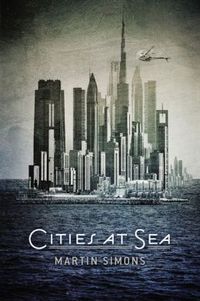
These are the support of people who dwell on water, for the Earth has flooded greatly and CITIES AT SEA are all that remain of large population centres. Like everyone, Sal wears a wrist terminal to identify and track her. She wishes to go to work in Shanghai in a laboratory and the authority in Sydney needs to evaluate her choice before she will be allowed to leave.
Sal is seventeen and she wishes to have a procedure to help her grow gills, so she could swim freely. The modification would be genetic, meaning that a new breed of humans could arise. Not everyone is in favour. For the first time in five hundred years, sea ice has formed an ice floe in the Arctic winter, while the high ridge known as Emaylia has an accumulation of snow. The planet may be cooling again, and both landlubbers and city dwellers will face challenges.
I enjoyed reading how the cities had come about and how they are kept apart in case of collision, but visits are encouraged when one draws near to another. Hydroponics and fish provide food and land farming is considered unclean and unhealthy. Wind vanes, turbines, solar collectors and fusion power are sources of energy, but mainly the cities drift on strong currents. Martin Simon, who lives in Sydney, has clearly put a lot of thought into constructing his future world. He considers that birth rates would be completely managed, so physical love has come to mean little more than casual fun to his young protagonist, and only when someone points it out to her does Sal realise that spending all day immersed would be hard on her skin so she might have to be given scales or blubber - who would want that?
The author has also researched resonant frequency, centrifugal force, weather and other engineering issues to make the story feel very real and we are conscious of potential hazards when a breakaway section of raft tries to go it alone. He believes that the more people depend on machines for survival, the more machine-like they will become. Sal is bravely determined to reverse the process. Read CITIES AT SEA and decide for yourself which method would enable humanity to survive.
No excerpt available.












 © 2003-2026