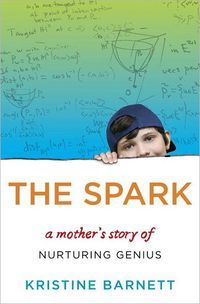
Subtitled 'A Mother's Story of Nurturing Genius' this book tells of a child prodigy, Jake, who overcame autism with the help of his parents, to astonish the world of physics by the age of twelve.
Kristine was a city-raised Amish girl who had to leave her community to marry Michael, in Indiana. Their son Jake was an early learner of letters and rhymes by heart. But by the age of two he began losing interest in other children. Kristine ran a daycare centre and saw the difference between Jake and other kids. Despite help from developmental therapists Jake stopped speaking. In October 2000 he got a formal diagnosis of Asperger's Syndrome, a form of autism.
"Autism is a thief", says Kristine. "It takes your child away, your hope, your dreams." Jake had a stunningly high IQ but preferred to spin in circles or look at lines than communicate. He got state-funded speech therapy, and family trips to the petting zoo. Therapists focused on skills Jake was failing to master. Kristine and Michael stood fast together and had a second baby boy. State funding for Jake stopped at age three but intervention works best up to the age of five. So Kristine kept working by herself. She noticed that Jake had lined up his crayons in the exact order of the colours of the rainbow. He had watched a water glass with the sun shining on it creating a prism spectrum.
Kristine was determined to give Jake a childhood. She let him play in a water sprinkler, count stars and feel dirt under his toes. But then Jake joined a developmental preschool. The teacher told her to stop sending Jake to school with his beloved alphabet flashcards - he might never be able to tie his shoelaces. Kristine rebelled and decided to teach him herself. She just wanted to focus on what Jake could do, instead of what he couldn't.
Allowed to assemble jigsaws and wooden puzzles, to add up long numbers and read words on signs, Jake relaxed and became more chatty. He worked out equations for himself, beat adults at chess. He memorised driving atlases and could give explicit directions. All this by the age of four, though he still couldn't say how his day had been. Kristine set up a group for other autism spectrum kids. One child excelled at art, another at taking computers and TVs apart and repairing them, and given the chance at Kristin's new after school charity, Little Light, they flourished and demonstrated considerable talent. Their exhausted parents were overjoyed.
Aged three Jake went to an observatory lecture on Mars and astronomy; he had devoured an astronomy text and he answered a question effortlessly. Aged thirty however, with a new baby, Kristine had a serious stroke. She was diagnosed with an autoimmune disease lupus. Michael took the brunt of all the efforts that had to be made. Jake went to school and coped well. He sat with his mother and watched other savants on internet video clips, and he seemed to have many of their skills. Aged nine he began taking astronomy classes at university and working out complex theories. Encouraged, Kristine began a youth sports club for autistic kids. Everyone became more sociable and learned to have fun. Then the recession hit the family. "Everyone was broke and afraid. When the President comes to Indiana you know you're in trouble." Jake was tested for and encouraged to apply for college, aged ten. The bored kid was able to blossom.
Taking official online exams, earning his way into a maths course, viewing online lectures, Jake suddenly excelled. He joined Mensa and got an A in college math. Dr. Tremaine in Princeton confirmed that Jake had created an original theory in relativity and said that he could be in line for a Nobel Prize. Jake's first summer job, aged twelve, made him the youngest astrophysics researcher in the world. He was able to solve an outstanding problem that career math researchers had been working on for years. Outside college he plays with his brothers and enjoys life.
I found this tale fascinating and the level of Kristine's dedication not just to her own child but to those of other families was amazing. I did feel that these parents should have had more care with money - they spent their own cash on the charity and took no money from parents, so when the recession hit and they had a mortgage and a derelict building to renovate, with no work, they had no fallback and the family had to eat ramen every day and patch up clothes. For all of us who were profoundly bored by school, but could change nothing, Kristine's story provides moral support - the education system doesn't get it right for everyone. For parents raising children with special developmental needs of any kind, THE SPARK is a must-read.
No excerpt available.












 © 2003-2026