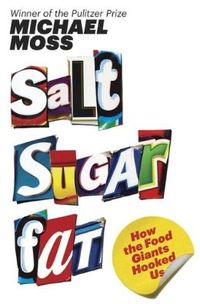
How The Food Giants Hooked Us is the wry subtitle of this intriguing read about what we eat and how it is prepared. Children too obese to play suffer from diabetes and the early signs of hypertension and heart disease. Why do the food giants add such quantities of harmful ingredients and fool us into thinking a yoghurt with twice the sugar content of a sweetened cereal is good for us?
SALT SUGAR FAT is the list of three main additives which make food more alluring, or specific to children's tastes. By the end of the 1990s with over half the adult American population overweight and nearly a quarter obese, healthcare costs were high and specific linked illnesses such as cancers were on the rise. Middle-class adults worked a second job to make ends meet and needed quick food, with no time for exercise. Generals testified in Washington that young people were too obese to recruit and surgeons blamed a rise in maternal deaths on overly fat mothers undergoing problematic caesareans. Yet in 1999 a meeting of CEOs of major food companies was presented with the alarming facts and totally refused to change policies.
Low-fat food often contains high levels of sugar instead, disguised by names such as fructose and dextrose. Sugar, fat and salt are cheap additives. Neurologists have found that the brain lights up on receiving sugar just the way it does for cocaine, so manufacturers are desperate to pour it into everything from breakfast cereal to main courses. This empty-calorie ingredient replaces tomatoes, fruits and grains. Salt brings out the taste of food and fat improves texture in the mouth, also adding bulk.
The tobacco industry is compared with the food industry; in some cases they had the same parent company and were undergoing the same threats - from people concerned about marketing to children and ingredients listings. Consumers and health boards are now conscious that these three food ingredients can be harmful in quantity.
Michael Moss persuaded some major firms to make him versions of his favourite products without the additives. Kellogg's made him a saltless cracker which he now found was like tasteless cardboard. Campbells made him soups with a reduced fat, sugar and salt content; they were either overly bland or metallic and bitter.
The text contains visits to molecular biologists and biopsychologists, results of lab rat experiments and comparisons with addictive drugs. We learn the science behind the term 'mouth watering' and see that food technicians experiment to add the three ingredients to food in the most innovative ways. Diet soft drinks made with saccharin make people prone to eat more. High-fructose corn syrup added to sweeten soft drinks makes people eat more and even when they don't they still gain weight.
This book covers some of the same ground as 'Fast Food Nation' - the demand for quick, easy, tasty, cheap food; the dubious methods used by industries to protect themselves, such as paying private food health inspectors to produce reports. Slaughterhouses refuse to supply meat to food processors unless they are guaranteed it will not be tested for e-coli bacteria until it has been mixed with meat from other producers. Living in Europe I found that astonishing. Here we put a huge value on traceability 'from farm to fork' and at the order of the Irish Commissioner, the whole of Europe is currently testing the DNA of processed meat products - alarming finds have included pork DNA in supposedly halal meat supplied to prisons and a supermarket own-brand beef lasagne which was 100 percent equine DNA; arrests have been made, meat producers closed and major contracts cancelled.
The message of Michael Moss's SALT SUGAR FAT is that no matter what we do about banning advertising to children of unhealthy foods, or taxing sweet drinks, the manufacturers are so dependent on their processes to make profits that they are not going to stop. We need to protect ourselves with correct nutritional advice and to make the right choices.
No excerpt available.











 © 2003-2026