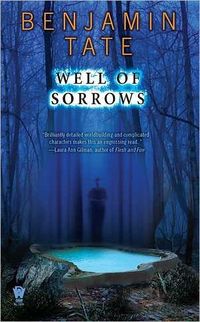
Benjamin Tate undertakes the difficult task of loosely setting high fantasy in a most familiar setting- the American colonies. His version of the New World pleasantly has only the barest associations to a world the reader might recognize. WELL OF SORROWS is actually incredibly unique, with scarcely more than a whisper of historical associations. Settlers still strive for dominance in a foreign land but are accompanied by a host of unique races, metaphysical dangers and-- requisite to any fantasy epic-- numerous and varied political machinations. Colin Harten is a young boy who is part of a frontier family sent west to claim more land for the humans but, in a series of highly unexpected twists, he is to lose everything that he once was and gain powers heretofore unknown to all the races.
Despite the novel setting and Tate's eloquence with the written word, I was at first reluctant to endorse WELL OF SORROWS. During the first quarter of the novel, it's difficult to say what the driving plotline might be and after the many changes prompted by the twist in the middle of the book, I felt alienated from the characters and their struggles. Happily, I realized I had reached a turning point with Tate's work when, while reading, I missed my stop on the subway- any book that can block out the noise of 400 rambunctious Red Sox fans is worth picking up. WELL OF SORROWS is a political and historical fantasy that creates a complicated backstory for its characters and uses most of its 500-odd pages to allow its hero, Colin, to evolve. Indeed, it is more of an origin story than anything else. One has the sense that subsequent novels will be more plot-driven and I can only imagine that they will continue to improve, as the author will have lost the need to shackle his story to the intricate (and, never fear, enjoyable) development of his hero. With room to explore the complicated landscape he has built, I predict an action-packed sequel on the horizon and based on the promise of the final page's revelations, I can only say- Colin's (and Tate's) work is not yet done.
No excerpt available.








 © 2003-2026