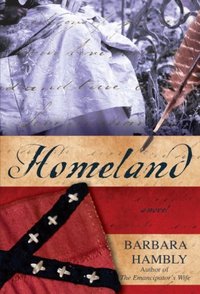
We have experienced friendships that have withstood the test of time and/or distance. Few of us likely have had friendships tested by war like the two characters in Barbara Hambly's new novel HOMELAND. Rather than a narrative, Hambly's book is comprised of letters from two close friends, who live on opposite sides of the Mason- Dixon line, but don't necessarily share the beliefs of their friends and families.
Susanna Ashford lives on Bayberry Run Plantation in eastern Tennessee with her father, brothers and sister who are all avowed confederates. Cora Poole married a close friend of one of Susanna's brothers, and to keep matters interesting, Susanna is in love with Cora's father-in-law. While Susanna has had slaves all her life, she isn't sure secession is the best thing, and Cora starts out with her husband Emory in Boston, but moves to Deer Isle in Maine to live with her family when Emory goes to war.
But Emory doesn't walk down the street and sign up. He goes south to fight with his childhood friends for his homeland. Cora is branded a "copperhead" and told she should divorce her husband as a traitor. Susanna and Cora are strong, intelligent and opinionated women who share all with each other. It seems many times they have no one else in which to confide. The letters cover everything from the everyday life of sugaring and preserving to going visiting to gossip to literature. They tell stories as the quick e-mails we dash off to friends and colleagues can't possibly do. It might seem that writing letters would be easier than maintaining a narrative, but I think it's harder as entire lives and experiences must be conveyed in correspondence.
Hambly, well-known for her fantasy tales and a historical series about a free man of color in New Orleans, has put a new twist on the historical novel in HOMELAND, but creates no less compelling a tale. It felt not so much like reading a novel, but sitting in my grandmother's attic, reading letters she had saved from her mother's mother. Susanna and Cora draw the reader into their lives, sharing experiences, emotions and hardships. The novel has much food for thought to impart, as well: when does a true friend tell the truth and when is it withheld? The letters don't shy away from details of the hard labors of daily life, having a militia in one's house, watching a loved one fade in front of one's eyes or the siege at Vicksburg. Barbara Hambly manages to make each genre her own, and this novel is no exception. Fans of historical novels, women's fiction and mainstream stories will enjoy this novel.
No excerpt available.




 © 2003-2026