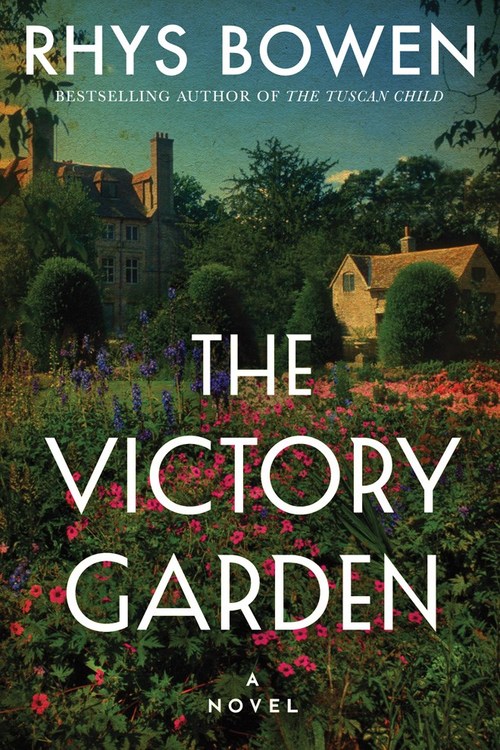
By the author of the madly popular Her Royal Spyness series comes a social history tale of women's fiction. Miss Emily Bryce has to obey her parents when they forbid her from signing up for war work. Her brother has been killed early in the Great War, and they don't want to lose her as well. She knits and visits hospitals near their West Country home. After she turns twenty-one, however, she volunteers for THE VICTORY GARDEN.
The Women's Land Army is a topic I've only recently seen covered, because it lacks the drama of frontline nursing. Women were required to take on many roles as healthy men over five foot tall were conscripted. Returning soldiers were too badly wounded to carry out farm work, and petrol was in short supply, so manual labour and horses were required. Emily is determined to do her bit for victory, and she won't be sent overseas.
The reaction from Emily's parents is priceless; they want her to work in an office, not toil like a peasant. The young lady just wants to be free, and she will get a wage and board. At once she meets Daisy, a housemaid who has escaped a life of drudgery. Emily starts to realise how little she's prepared for hard physical work. But she is determined to cope. And on her days off, she's going to be near the hospital where an Australian is recuperating, Flight Lieutenant Robbie Kerr. Her parents disapprove of him, but Emily has already noticed that after the war there won't be enough English men to go around. (As anyone who has read The Prime of Miss Jean Brodie will know.)
The first thing the ladies delight in doing is removing their corsets. They are a good hearty mix and demonstrate their capability. I spotted a scene like the one in "Private Benjamin" where the heroine's parents come to try to get her out of the army. I'd like to think most parents would not react that way, but rigid class structures were being smashed for the first time. We see this again when, assigned to work at a grand house, Emily naturally goes to the front door but is told to use the kitchen entrance. And the Land Girls visit a village pub, normally the province of men -- but there are no men under seventy in the village, apart from the Reverend.
Emily becomes fiercely independent and achieves more than she'd ever dreamed. She carries on the work of a line of herbal women, knowing tragedy as well as joy. THE VICTORY GARDEN is a good way to commemorate the Great War and those who were left behind. Sit back, add honey to your mint tea, and enjoy this well-plotted and carefully researched book.
From the bestselling author of The Tuscan Child
comes a beautiful and heart-rending novel of a woman’s love
and sacrifice during the First World War.
As the Great War continues to take its toll, headstrong
twenty-one-year-old Emily Bryce is determined to contribute
to the war effort. She is convinced by a cheeky and handsome
Australian pilot that she can do more, and it is not long
before she falls in love with him and accepts his proposal
of marriage.
When he is sent back to the front, Emily volunteers as a
"land girl," tending to the neglected grounds of a large
Devonshire estate. It’s here that Emily discovers the
long-forgotten journals of a medicine woman who devoted her
life to her herbal garden. The journals inspire Emily, and
in the wake of devastating news, they are her saving grace.
Emily’s lover has not only died a hero but has left her
terrified—and with child. Since no one knows that Emily was
never married, she adopts the charade of a war widow.
As Emily learns more about the volatile power of healing
with herbs, the found journals will bring her to the brink
of disaster, but may open a path to her destiny.
EXCERPT
As she came to the top of the first flight, she heard raised
voices. Then a male voice said, quite distinctly, "Aw, bugger!"
"Such language. Behave yourself, Flight Lieutenant Kerr,"
said a booming woman's voice. "Just lie still. I'm not going
to hurt you."
"Not going to hurt me? It's about time someone taught you
how to change dressings without ripping off half a patient's
skin," replied a man's voice with a strange accent.
Curiosity drew Emily to the open door. The man lay on a
narrow bed, the large figure of a nurse looming over him. He
was the most handsome man she had ever seen. He had unruly
red-blond hair and a tanned, outdoor look to him quite
unlike the pale English young men Emily was used to. She
hadn't realized that she was standing and staring until
suddenly he looked up past the nurse and spotted Emily
standing there. She had no time to shrink back out of sight.
His eyes lit up, and to her embarrassment he winked at her.
"I'm doing my best, Lieutenant," the nurse said. "You have
to understand that changing burn dressings is not an easy task."
"Not with sausage fingers like yours," he replied. "You
ought to let that young lady volunteer do it for you. Look
at her dainty little hands. I bet she wouldn't skin me alive."
The nurse spun around to see Emily standing there,
red-faced. "This young lady is only a visitor," she said,
"and would no doubt be horrified at your language. And for
your information I qualified at one of the best London
hospitals and have changed thousands of dressings."
"Old cow," the man muttered.
"What did you say?"
"I said, ‘Okay for now,'" he replied, looking up at her
innocently. Emily turned away, pressing her lips together,
afraid she'd burst out laughing.
"Don't go," the young man called after her. "Come and talk
to me. I haven't seen a pretty face in months."
"I'm afraid I have to take these cakes up to Matron's room,"
Emily said, conscious of the nurse glaring at her.
"You're not even going to share your goodies with poor
wounded blokes like us?" he asked. "We're the severe cases,
you know. All flyers."
"You're not severe, you're all hopeless," the nurse said,
"and I've no doubt that the young lady will be back with
cakes for you when it's your turn. But only if you behave
yourselves."
"We'll all be as good as gold, Nurse," he said, and he shot
Emily a grin as she turned back to look at him.
The nurse followed her out into the hallway. "I must
apologize, Miss Bryce. He's Australian, you know. No sense
of propriety or decorum, as far as I can see. We've just
received several of them into this ward. All members of the
Royal Flying Corps—aviators, brave boys. Personally, I think
they need their heads examined, flying in the sky with a
craft that is essentially held together with paper and
string. So I am trying to give them more leeway than I would
in normal circumstances—knowing what lies before them, I mean."
When Emily looked at her curiously, the nurse moved closer
and lowered her voice. "The life expectancy of a pilot in
the Royal Flying Corps is six weeks, Miss Bryce."








 © 2003-2026