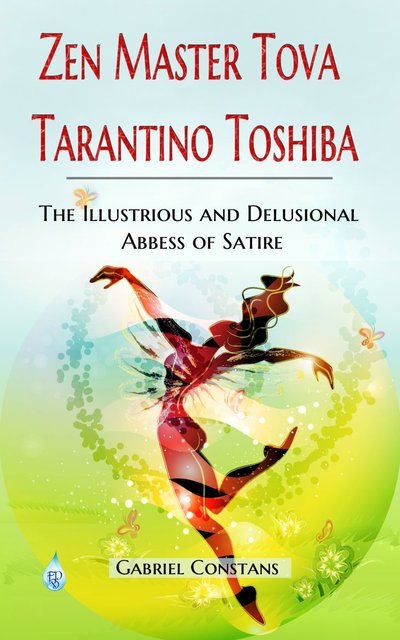
As the title implies, ZEN MASTER TOVA TARANTINO TOSHIBA: The Illustrious and Delusional Abbess of Satire is a scathing satire on religion and philosophy. Alternatively known as a man or woman, or other, Master Tova is in turns Imam, Rabbi, Reverend, depending on the source. ZEN MASTER TOVA TARANTINO TOSHIBA's teachings are presented as a collection of quotes and short stories, from a few words to a few pages. The sayings were supposedly collected over the years, all around the world, from presumed descendants, students and disciples. And predictably, there are many offspring of the famous Master who bear famous people's last names. As it happens, whichever school of thought or religion you might think of, errata were made as to the founder: everything obviously begins and ends with Master Tova.
Master Tova comes off as rather clueless, she shows little empathy, she doesn't listen to anyone. She cares only about one thing: herself, and she definitely doesn't practice what she preaches. After all, she is the One who knows, the One who preaches, the One to listen to. Some advice could endanger other's health or life, but surely that's their own problem. And so she will meditate, which surprisingly is very much akin to sleeping, but for Master Tova, it is a profound state of some sort of awareness or other.
I liked that the tone of the various stories differs according to the time, place and source from which it purportedly originates; at times sounding like a Jewish mother, a Chinese philosopher or a Valley Girl, Master Tova never fails to astonish. At the back of the book, we find praise for the book from very famous people whose names seem to bear uncanny misspellings... But that's not the point, is it?
There is one thing I found interesting and quite unsettling about ZEN MASTER TOVA TARANTINO TOSHIBA: The Illustrious and Delusional Abbess of Satire is a scathing satire on religion and philosophy. It demonstrates how easily the words of great thinkers, be it Heidegger, Augustine or Derrida, can be misconstrued or misapprehended: a misunderstood term, a few omitted or misplaced words, and profound thinking becomes asinine, illogical and completely irrational. And it makes for a very amusing little book that turns profound thinking on its head.
No excerpt available.








 © 2003-2026