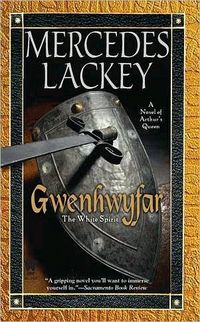
I always get nervous whenever a writer decides to tackle the Arthurian legend. There are some truly classic works on Arthur, and any modern writer is treading in the shadows of giants. You just can't beat Thomas Malory Le Morte D'Arthur or T.H. White The Sword in the Stone. The rare few manage to come up with a refreshing take, Mary Stewart The Crystal Cave and Stephen Lawhead The Pendragon Cycle, but most authors just aren't up to the task. (And I won't even talk about some recent movies.) After more than my fair share of overwrought, self-important, and just-plain-awful takes on Arthur, I was not looking forward to reading Mercedes Lackey's, GWENHWYFAR. In the interests of critical review, I overcame my trepidation, and was quite pleasantly surprised to find that GWENHWYFAR is actually pretty darn good.
Lackey's tale is centered around, not surprisingly, Gwenhwyfar (Guinevere), the daughter of one of Arthur's kings. It follows her as she grows up in her father's household, becomes a skilled warrior and scout, and as she becomes wrapped up in Arthur's fall as his last queen. Rather than choose between one version of the tale versus another, Lackey essentially chooses that they are all true and runs with them. For most of the book, it's not really about Arthur at all, with the grand scope of the legend serving as incidental background to the story of Gwenhwyfar's education and exploits in the field. Her education as a soldier is well described, as are her exploits in the field. And Lackey does a great job capturing the clash of cultures of the Romans and Celts that took place in (allegedly) Arthurian times. She even mixes in some fae lore and magic to the story, making for an enjoyable, earthy story of a woman making her way in medieval time. Lackey also (mostly) avoids that all-too-common trap of portraying an idyllic, egalitarian society that was wonderful for everybody, until the Christians show up and ruin everything.
I do have a few complaints. The story is at its best when it's not about Arthur, and for most the story, it isn't. It's when Gwenhwyfar becomes involved in the story proper that it becomes a lot less enjoyable. Rather than flowing naturally into the legend, it almost feels hammered into place, with the author shoving the character's around to make it fit. Also, I don't speak Gaelic or Welsh. I know enough to know that Gwenhwyfar is pronounced roughly like Guinevere, but I don't know how to pronounce Cnwclad, Annwn or Yniswitrin. Some help would have gone a long way.
That being said, it's still quite good. Surprisingly so. I am reminded of why I have enjoyed reading Mercedes Lackey in the past, and a refreshing take on Arthur. The trouble is, now I want to go back and read Stewart and White all over again.
No excerpt available.







 © 2003-2026