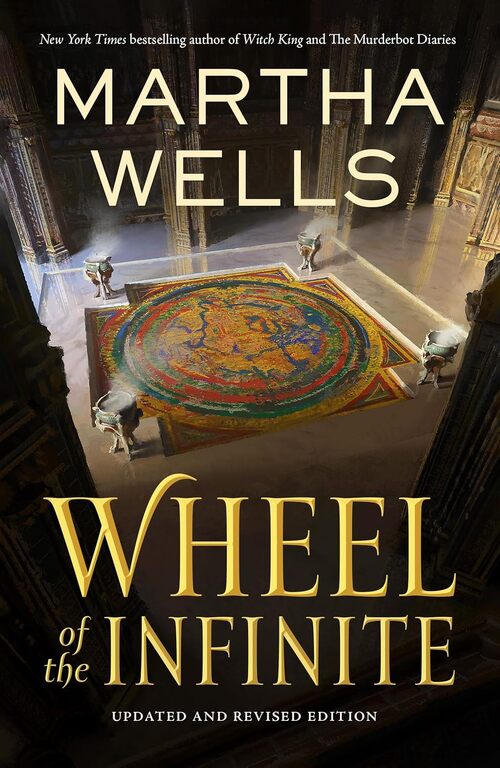
Maskelle is a woman we meet on the mucky road with a troupe of players. She’s not one of them, though they do her bidding with a smile and a song. WHEEL OF THE INFINITE is a detailed fantasy based somewhat on Southeast Asia, and our heroine is in exile.
The dark fantasy is reissued to delight Martha Wells’ keen fans, and shows decent signs of worldbuilding early, with explanations mainly issued through conversation. The middle-aged, widowed, female wizard has royal connections, we later learn, but for now, she’s just heading at an ox’s pace to the big city. Looking for healing herbs near a river inn, she aids a captive, Rian, and the swordsman joins the troupe. If you enjoy a bodyguard fantasy, Rian is also in exile from a different kingdom but was previously serving as personal bodyguard to a brutish king. His heart is clearly good, and Maskelle finds him attractive.
Duvalpore is where the Wheel of the Infinite, a model of the world as known, must be remade annually, and this is a century year that carries more power. As we can expect, someone tries to sabotage the Wheel. Maskelle’s title is the Voice of the Adversary, a temple divinity. She is summoned back to help fight whoever or whatever is causing the problem. The troupe is delighted to put on performances in the capital city of the Celestial Empire, and there’s also a hope that someone can remove the curse on their string puppet.
I’ve noticed that Well’s books tend towards horror. There were deaths, possessed people, cursed inanimate objects, howling spirits – but not too many at first, so I had lots of time to get to care about the characters and want to solve the murder mystery. I could have done without the puppet, but its main function is to tie together the first roadside half of the book and the second urban half. The story deals with both human motivations and demons, but of course, in fantasy, all options are on the table. I kept reading, and my main annoyance turned out to be that the vast majority of people in positions of rank are male. There isn’t even a courtly dowager or high priestess. We spend a lot of time in temples and fine halls, again removing us from the townsfolk. So, make the most of the actors, and the quips between Maskelle and Rian.
The ultimate theme of WHEEL OF THE INFINITE is to let go of regrets and hatred. Move forward and make a brighter world. Martha Wells has got that concept right, and this lively fantasy will keep you engaged.
No excerpt available.









 © 2003-2026