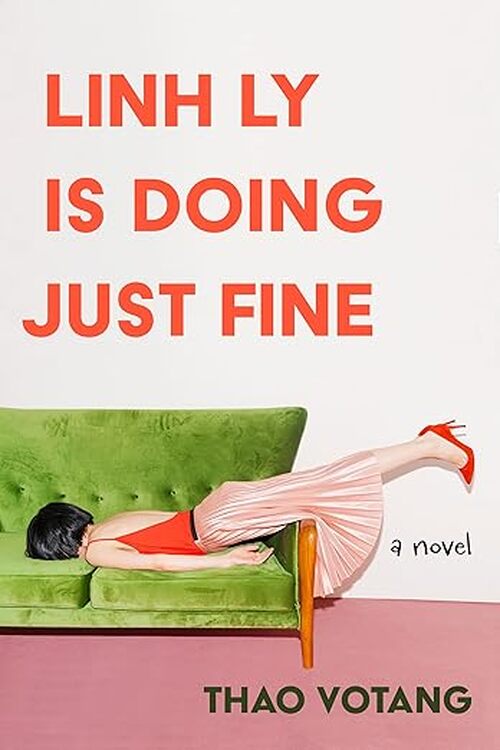
The cover of LINH LY IS DOING JUST FINE spoke to me. I mean, who hasn’t wanted to just faceplant onto the sofa and stay there? However, whether or not Linh is doing just fine is debatable. Linh narrates her story in first person POV. It’s not my favorite POV, but sometimes it works well, and this is one of those times. There isn’t a lot of plot, though Linh is constantly going somewhere or doing something. Little plotlets I guess, make up an interesting slice-of-life character study.
Linh grew up with a mean alcoholic father and a mother who worked two jobs, leaving Linh to fend for herself after school every day. She loves her mother fiercely and hasn’t talked to her father since her parents divorced a year ago. She lives a very solitary life and considers Hoa, who is also Vietnamese American, to be her only friend. When the college she works for switches to remote working after a school shooting, her life becomes even more solitary, which she revels in, happy to be at home and not have to see or hear her coworkers.
Linh is an introvert who constantly finds herself in awkward situations, providing the basis for much of the humor in her story. But what riveted me more was that, as a Vietnamese American, she seems to feel straddled across the two identities, much like the Thanksgiving dinners her mother would prepare featuring both Vietnamese and American food: “Two cultures were eaten together and swallowed with no consideration of how the flavors would or would not mix.” I felt like that was almost a metaphor for Linh’s life. There is so much in the news and around us about racism, but thinking about it I feel that most of what I see and hear is about racism towards the Black community. So I will admit it was a bit eye-opening to read Linh’s experiences as an Asian American, as she casually mentions incidents from her life, or when talking to another Asian woman at a party she tells us, the reader, that in the past she would’ve avoided such a situation because “Someone might think we were teaming up to cause trouble…”. When some of the women on her tennis team kept inviting her to meet up with them for breakfast after practice, I was happy for Linh to start forming friendships, but she would wonder why they wanted to be friends, and would second guess their intentions, that maybe it’s the novelty of having an Asian in their circle that appeals to them. And when she questions why Chandler, a white man, wants to spend time with her rather than his glitzy rich friends, she tells him it’s because she’s exotic, only to be gently rebuked.
Linh’s relationship with her mother was also fascinating. Her mother has started dating, and Linh googles the men her mother dates, and stalks them on their dates, critiquing the men’s cars or the places they take her. Eventually, she begins following her dad as well, but whereas with her mother it stemmed from the need, and the duty in Linh’s eyes, to protect her naive inexperienced parent, with her father it felt more like an effort to connect with him somehow, without having to actually interact with him.
The book ends rather abruptly, with no obvious resolution to anything. Which is much like life – one day ends, another day will begin, and life just continues. Though I would have liked more resolution to her relationship with Chandler. But even if I’m not sure that LINH LY IS DOING JUST FINE, I am left with the sense that she will, indeed, be just fine.
No excerpt available.













 © 2003-2026