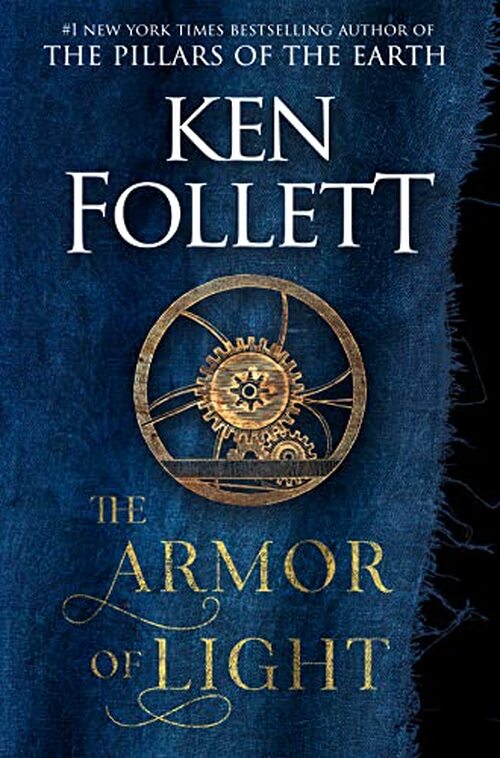
Kingsbridge is a town and a series, the town being an imagined crossroads in the west of England, the series by Ken Follett being among the most popular historical fictions in the world. We return to Kingsbridge at another major turning point in history in THE ARMOUR OF LIGHT, covering 1792 to 1824. This wool-producing and cloth-making town has to compete with imported cotton spun in the north on steam-powered looms. Yes, the Industrial Revolution is here.
Sal and Kit Clitheroe are widowed and orphaned when a runaway cart crushes Sal’s husband. Kit goes to work as a boot boy in the Squire’s house, fearing the temper of the Squire’s son Will Riddick but idolizing the younger brother Roger, a student and inventor.
Kingsbridge has swollen, with many districts a good walk from landmarks Prior Philip’s Cathedral and Caris’s Hospital. Other inhabitants include weaver David Shoveller, nicknamed Spade, and Amos Barrowfield, a hard-working cloth merchant who adores Jane Midwinter, the haughty daughter of the Methodist Canon Midwinter. Where religion was central and dogmatic in the earlier books, the Reformation has changed all that. Bishop Stephen Latimer represents the Anglican heritage. He controls the cathedral, and much ceremony and influence, so he is a friend of the wealthy. His wife Arabella and daughter Elsie are moderate, and Elsie gains permission to run a Sunday school for the working children who have no other day to attend classes. In this, Elsie makes a friend of Amos, whose Methodist beliefs about worshipping simply and helping the poor inspire many events. Even when we know the facts, seeing the effects on ordinary folks, makes enforced poverty very real.
Rows of homes are thrown up to house mill workers, as household weavers and spinners can’t meet the market. Watermill power is sufficient at the start, but before long one enterprising employer decides he would be able to pay fewer men, women, and small children if he used coal for steam power instead. This causes the formation of the first trade union, but a law is passed that bans unions, and any workers combining to act against businesses may be hanged, flogged, jailed, or transported. Press gangs are also seizing able-bodied men to make up the Army and Navy. Their families are not informed or paid. No wonder some folks voiced sympathy for the French Revolution and even Napoleon, whose armies rampaged across Europe for over twenty years.
The Battle of Waterloo was the defining moment of the generation shown in THE ARMOUR OF LIGHT. The Napoleonic Wars were their World War, robbing homes of husbands and sons and towns of labour and trade. The steam power was needed because so few men were left, whereas the demand for cloth to make uniforms had never been greater. I found the actions of the wealthy minority despicable, denying parish aid to a mother whose husband had been pressed, hanging a boy who stole because he was starving, and forbidding a local shop to make workers buy from their large stores in the market square. During some chapters, I could see Ken Follet maneuvering to bring his main characters to Brussels. The battle is well described, and he brilliantly gives the view of one of the soldiers’ wives following the camp. Of course, not everyone can survive. But enough of our friends survive that we can see a happy outcome, a blessed peace descending.
THE ARMOUR OF LIGHT outfits Kingsbridge in style, displaying progress in a generation and quietly introducing gay relationships. Fans of historical fiction will find much to please them, some romance and some wartime, heroic characters making the best of the day given to them. Ken Follet researches well and holds our attention on every page.
No excerpt available.











 © 2003-2026