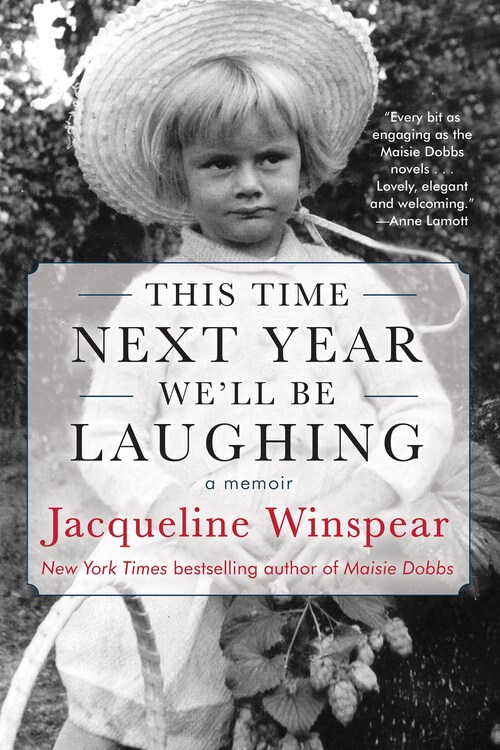
If you enjoy reading memoirs by authors you follow, this may be your pick of the year. Budding memoir writers are often told, write it into a fiction novel instead. Fiction sells better for those who are not famous. More than once as I enjoyed Jacqueline Winspear’s memoir THIS TIME NEXT YEAR WE’LL BE LAUGHING, I recognised a situation or character. But these are her parents’ memories, or her uncle’s, those of the War, the Blitz, painting huts on airfields with toxic anti-inflammatory paint, for instance.
Having fictionalised the lives of those near to her in the acclaimed ‘Maisie Dobbs’ historical detective series, the author has returned to tell it straight. Or as straight as we can know, after the passage of time. She was told all these stories during different parts of her upbringing and young married life, and only now is she wondering if all of them were true. One in particular, her mother’s tale of the perilous Blitz, was certainly true for many people. Perhaps her mum just used this to explain to a young daughter why she was evacuated as a child to the countryside.
Kent, home of hop-growers and orchards, was the summer destination for many Londoner families who gained health and wealth by picking crops. Following the War, a young married couple could not find housing and took a chance on buying a gypsy caravan, living snug alongside Romani Gypsies and following their lifestyle. The farms in rural Kent, dark and muddy over winter, were always glad of hands, but didn’t pay well. Only when a baby was expected did they get to move to a farm cottage where Jacqueline and later her brother were born.
Children were treated differently. Jaqueline remembers being reproved, quieted, falling often and needing stitches. The hushing is explained by a relative having shell shock from the Great War. The falls turned out to be partly caused by poor eyesight which required surgery. Her memories jump around in the telling, so at one paragraph she tells us about her childhood, then she skips to describe her older mother, having had a career administering prisons, dropping china cups daily as an illness progressed. She concludes by closing the story of her parents’ lives – spent close together and with love for the countryside. As her dad used to say to cheer them all up, THIS TIME NEXT YEAR WE’LL BE LAUGHING. Even if the laugh can’t be guaranteed, we do get the sense that time marches on, and lives seem short at the last. Live a full life, is Jacqueline’s parting message. I hope she goes on to write us many more detective adventures, especially now I know where she got all her ideas.
No excerpt available.








 © 2003-2026