Initially discovered in 1878 in an elite Viking grave chamber on Bjorko (Birch Island), the site of an ancient Viking community, the bones and grave goods of a Viking warrior were determined through DNA testing in 2017 to be those of a woman. This and similar findings have altered archaeological and historical views of early Viking life and the long-held belief that only Viking men became adventurers, raiders, and traders while Viking women remained at home, rearing the next generation and keeping life moving ahead.
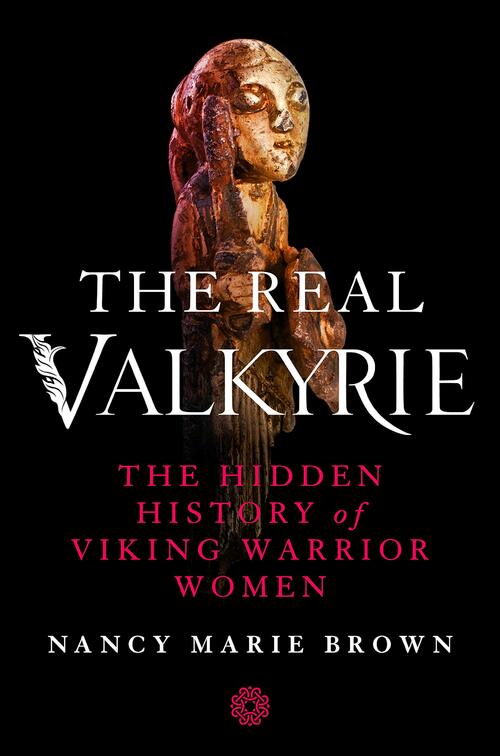
With only the bones and remnants of the grave goods from the elaborate burial chamber, author Nancy Marie Brown has woven together a fictionalized story of the warrior woman’s, or “valkyrie’s” life in THE REAL VALKYRIE. She accomplishes this by incorporating the evidence presented by these remains with the latest interpretations of the plethora of Viking sagas, songs, myths, legends, and lore. Additionally, she has gathered other collaborative documentation from the numerous cultures the Viking traders and raiders came in contact with during their 300 years of domination, exploration, marauding, and as they established trade routes east into the Baltics, Byzantine, Baghdad, and beyond.
Each chapter leads off with a brief vignette of what the warrior woman’s life could have been. Dubbed Hervor, after the main character of one of the better-known sagas, she is introduced as a young girl whose community is attacked by an enemy band of Vikings. She is enslaved, only to find herself a member of the victor’s queen’s household, where she flourishes and eventually becomes the independent and successful leader of her own warband, as indicated by her well-appointed grave chamber.
Following Hervor’s story, supporting material for the details of Hervor’s imagined life is then presented and explained. This gives the reader a real feel for the place, time, history of the Vikings, and their way of life and includes discussions of weapons, ships, boat and boat building, and my favorites, their clothing. One of the most fascinating aspects revealed is how Viking artifacts have been uncovered throughout Northern Europe, Great Britain, North America, and along the trade routes leading to the Far East.
Merging the academic details with the fictionalized version of Hervor’s life makes for interesting and enlightening reading. The author’s writing style is comfortable and creates an authentic, plausible, and engaging story. I really wanted to have more of Hervor’s imagined story. The detailed and informative backup material lured me in and made me want to read more on the subject, including the highlighted source documents and old Norse sagas. Thankfully, the author provides a section titled “Further Reading” to make this easier.
The book is an amazing amalgam of research, creativity, and imagination. I recommend THE REAL VALKYRIE to readers that want to read the real story of the Vikings or who have enjoyed historical fiction featuring this subject and time period but are looking for something more substantial (and substantiated), and especially readers who have enjoyed such popular media as the television show The Vikings but want to read an interesting and engaging history of the basis of the fiction.
In 2017, DNA tests revealed to the collective shock of many scholars that a Viking warrior in a high-status grave in Birka, Sweden was actually a woman. The Real Valkyrie weaves together archaeology, history, and literature to imagine her life and times, showing that Viking women had more power and agency than historians have imagined.
Brown uses science to link the Birka warrior, whom she names Hervor, to Viking trading towns and to their great trade route east to Byzantium and beyond. She imagines her life intersecting with larger-than-life but real women, including Queen Gunnhild Mother-of-Kings, the Viking leader known as The Red Girl, and Queen Olga of Kyiv. Hervor’s short, dramatic life shows that much of what we have taken as truth about women in the Viking Age is based not on data, but on nineteenth-century Victorian biases. Rather than holding the household keys, Viking women in history, law, saga, poetry, and myth carry weapons. These women brag, “As heroes we were widely known--with keen spears we cut blood from bone.” In this compelling narrative Brown brings the world of those valkyries and shield-maids to vivid life.
EXCERPT
Before books, there were stories. In them was distilled the knowledge each generation wished to pass on to the next. Storytelling was (and is) a form of power. It was time-binding: It linked then to now. Told eloquently, at the right time to the right listeners, a story shaped the future. Told often enough, in as many ways as possible, a story became indelible. Such a story is the one told of Eirik Bloodaxe’s great-grandmother, Queen Asa.
The story was still being told when Snorri Sturluson visited Vestfold nearly three hundred years later. As he relays it in Heimskringla, Asa was the only daughter of King Harald Redbeard, who ruled Agdir, Norway’s southernmost kingdom. Gudrod, king of Vestfold and two other kingdoms at the head of Viken, sent messengers to Agdir asking for Asa’s hand. Asa might have preferred to marry Gudrod’s grown son, who was exceedingly handsome and tall, for the Hunting King had already seen one wife to the grave. Or Asa may have been a shield-maid who wished not to marry at all. Whatever the reason, her father refused Gudrod’s suit.
The Hunting King swept down from the north with many ships. He took Agdir by surprise, surrounded the king’s estate, fired the thatched roofs, and turned his Vikings loose to plunder. Fighting against heavy odds, Asa’s father and brother were killed. Asa herself was captured and raped by her father’s murderer. She kept her dignity and contained her rage. When she became pregnant, he made her his queen. When their son, Halfdan the Black, was a year old, she took her revenge.
The Hunting King and his queen were on their autumn progress, sailing from one chieftain’s estate to another, enjoying a harvest feast at each one, dispensing justice, attending rituals, witnessing oaths and boasts, and generally reminding their subjects who was in charge. At Stiflu Sound (a place still unidentified by modern historians), Queen Asa saw her chance. At the end of the quay where they’d moored the royal ship she’d noticed a thicket of trees. That night there’d be no moon.
She posted her errand runner in the thicket. She ran her thumb up the edge of the spear she’d given him and was pleased to see beads of blood well up. He’d whetted it as sharp as her need for vengeance.
If he survived she’d make him rich. He wouldn’t survive. She couldn’t help that. The king’s bodyguard were berserks—his best fighters. She refilled the king’s mead cup and re-entered the tent on the ship, where he slept.
Late at night the king went on land, looking for a woman, as she knew he would. He was very drunk—she’d seen to that. It was very dark. When he reached the thicket, the boy leaped out and ran him through. The Hunting King fell into the water, dead.
So far, the story of Queen Asa is what you’d expect of a Viking queen. She is tough, decisive, unbowed—but still helpless. She has, as sociologists say, no agency. She can plot revenge, but not execute it. She can provide the spear, but not make the thrust. She is reduced to getting her way through “deep-wrought wiles,” in the words of the ninth-century Norwegian poet Thjodolf of Hvin, who preserved Asa’s story for posterity. He called her wicked and the murder foul-play.
Snorri Sturluson didn’t say much more, when he expanded on Thjodolf’s poem in Heimskringla. Yet, for me, the few lines he added change everything.
The next morning the king’s killer, hacked down at the quayside, was seen to be the queen’s errand runner. King Gudrod’s warriors confronted her. Queen Asa, said Snorri, “did not deny it was her plan.” You’d expect her to be executed; instead, Snorri wrote, Asa “at once” took her infant son Halfdan and went south to Agdir. There, she “reigned over the kingdom that her father, Harald Redbeard, had ruled” until Halfdan the Black grew up. “He was eighteen years old when he took over the kingdom.”
Given the length of Snorri’s book, it’s easy to overlook what Queen Asa’s revenge reports about women and power in the Viking Age. At once she proceeded south. She established herself in Agdir as the ruling queen. What does that say about her agency, her ability to act independently?
It says she needed no help from any man. Her father and brother and most of their warriors were dead—or still south in Agdir if they had escaped the Hunting King’s attack. She alone had been captured and kept captive, though queen in name. Her son was an infant. Alone she faced down her dead husband’s warband. Alone she faced down her son’s tall, handsome half-brother. She faced down the chieftain at whose quay they were moored. She not only escaped punishment, she left at once. Regally. Like a warrior queen no one dared cross. She must have taken the royal ship. She must have taken all the ship contained, including its crew, whose sworn oaths she exacted. She returned to the kingdom of her birth and established herself there, ruling Agdir for seventeen years.










 © 2003-2026