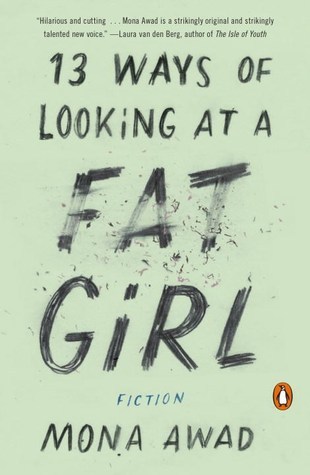
13 WAYS OF LOOKING AT A FAT GIRL is not really a novel, but it is. It's a cohesive narrative broken into multiple points of view that leads it to feel like a kaleidoscope view of a character instead of a full one. In her debut novel, Mona Awad looks at the politics of policing women's bodies, both internally and externally, through the myopic view of one woman.
Lizzie starts out life as a "fat chick" in suburban America, taught that her body was an enemy to be conquered and a commodity to be dealt. Throughout the narrative, she never connects her sense of self with it, instead connecting that sense of self to other's views on her body. She diets and hates herself, eats and hates herself, does anything else and hates herself. Awad shows us what it looks like when a woman is never taught that she's worthy beyond her physical body.
The toxicity that Lizzie carries within herself is insane, but is reflective of so many women I know. It is wrapped up in control mechanisms, in ideas of self- esteem that never really happen. The humor in this book comes from the observations of daily life, the way that Lizzie is always an outsider in whatever world she lives in. When she's thin and popular, she hates herself and her marriage is a sham. When she's fat and miserable, she wallows in that misery and her humor is her shield.
This book left me raw. Awad is not interested in comforting readers and her insights cut like knives against cultural constructions of femininity and womanhood built up over centuries. Her views are not new, but by using multiple views of Lizzie as a main character but not always narrator, Awad sheds sharp points of light onto the subject.
No excerpt available.












 © 2003-2026