For most people getting kicked by a spooked horse would be very bad news; especially in England in 1363 where a person might never be able to ride again or potentially die from the injuries. Yet, when the event happened in Oxford in that selfsame year, it is a Godsend for both the rider and the newly trained surgeon who attends him. Fresh from his year's medical training in Paris after graduating from Oxford, Hugh de Singleton, the fourth son of a minor knight from Lancashire, is badly in need of coin and clients. For Lord Gilbert, he is fortunate to be immediately treated by someone who not only saves his leg, but he now has a reliable and trustworthy surgeon to do his bidding.
After accepting the patronage of Lord Gilbert in Brampton, Hugh is even happier as he now has a house, good coin in his pocket and much better food in his stomach. So when a skull and bones are found in the cesspool at the base of Brampton Castle wall, Hugh cheerfully responds to examine the bones. Now, Hugh is charged to find out who is the victim as well as who might have caused this horrible death. Hugh has never investigated a death before. Is he up to this tremendous task? He is new to the area - will people trust him enough to talk to him?
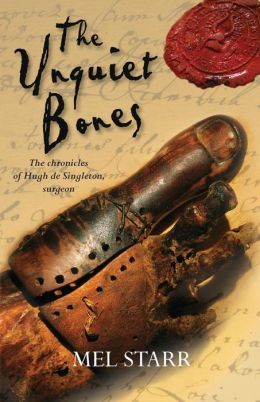
THE UNQUIET BONES is the first in a new series of medieval mysteries, called The Chronicles of Hugh de Singleton by Mel Starr, a gifted writer and former history teacher with a love of medieval surgery and mediaeval English. Right from the first uncovering of the bones in the cesspool, Starr instantly pulls you right into the sights, sounds and smells of medieval Brampton, a village slowly recovering from the many deaths from the Black Death, and this unusual and perplexing situation facing Hugh.
While the writing in THE UNQUIET BONES is clear and easy to read, Starr keeps the reader fully immersed in the medieval mindset by his liberal and appropriately used sprinkling of medieval words and turn of phrase in the conversations Hugh has to resolve this mystery (A Glossary and map are included). I thoroughly enjoyed this first chronicle of Hugh's adventures not only for the mystery, but especially for his descriptions of everyday life in the villages as well as for the details of his growing medical practice and the cures he employs.
As THE UNQUIET BONES is written in the first person, we readers are privy to Hugh's innermost thoughts and perspectives as he reflects on situations or his feelings about the people he has conversations with. Hugh is an intelligent, observant, and quick witted character that will appeal to many readers. He is grateful, kind, and bases his beliefs on religion not only on what he has been taught, but also on his readings of the gospels, some of which he can afford "to rent" for a time. Starr's descriptions of the secondary characters also seem very authentic for the time period.
As Hugh is now in his twenties and with a house, his thoughts turn to love and how much he would like a wife, especially to keep him warm at night. Starr wonderfully captures Hugh's "caught in the middle" situation as he aspires for the love of a Lady far higher up the nobility chain; yet, refuses to consider women below his station in life. In THE UNQUIET BONES, Starr skillfully creates a captivating romance along with a perplexing puzzle that is sure to please both history and historical romance fans who will appreciate the author's sense of the time, historical accuracy and vivid scenes.
If you are ready for an intriguing medieval adventure, I highly recommend THE UNQUIET BONES. Next in the series is A Corpse At St. Andrew's Chapel... isn't it great when you can start off on a new series and the next chronicle is waiting for you? So don't delay and enjoy being in the 14th century!
No excerpt available.









 © 2003-2026