Virginia married Oliver Marbalestier, a research scientist; now he's a textile firm's commercial manager. Her background in a trailer park led to a fierce desire to succeed and rebel; in California, she took it for granted that the pop singers and eccentrics were the establishment. As a student she married an Englishman, never dreaming that they would end up comparatively wealthy.
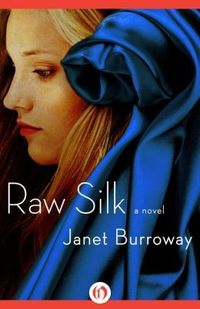
RAW SILK follows the path of the marriage, told by Virginia with an almost disinterested air, the charge of excitement only filling her words when she tries transferring her flower paintings to silk screen printing and becomes a pattern designer for the firm. Living in England, she doesn't fit in to the sedate cocktail parties with other company couples, but accepts that she needs to play the game. Then she and Oliver row over where to send their wilful daughter Jill to school, among other matters. I found it funny and snobbish that they name the dog Phaideaux - pronounced Fido.
My favourite character is a designer named Malcolm. Chatty and talented, he designs beautiful prints and camps it up when he wants to be funny. As he's no threat to the marriage he becomes Virginia's friend and she starts working in a studio next to his. This is better than the chilly life she now leads at home. A new assistant, a college dropout, is anorexic and heavily depressed by existential anguish, so creditably Virginia tries to help this girl; the counterside is that her marriage is sliding fast into non-communication and emptiness. Oliver turns out to be an appalling snob. Virginia, absorbed in her art, turns out to be a plagiarist and thief.
In the telling I kept feeling similarities to Lionel Shriver's We Need To Talk About Kevin. I can see no reason why Virginia did not request a divorce. The final section, set in Japan, feels the least convincing. The times are carefully described; the three ages of looms from Victorian on, still in use; the gradual devouring of the textile industry by Eastern firms with their cheap labour and consequent ill-feeling among the British labour force. Shot through with information, such as that cloth is a product with high value relative to weight, we learn a great deal from RAW SILK, including that our choices do not always make us happy. Janet Burroway has written several novels and plays, and this assured novel of three contrasts - American, English and Japanese - will reward the thoughtful reader.
No excerpt available.






 © 2003-2026