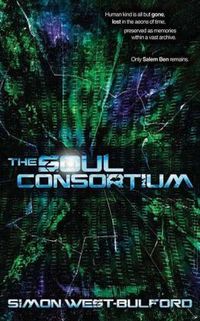
Simon West-Bulford's debut novel, THE SOUL CONSORTIUM, combines science fiction, thrilling action, and historical overtones. In the far distant future, humanity has gained immortality, making death meaningless. All of mankind except for Salem Ben has terminated themselves because of boredom, but Salem doesn't want to pull the plug until he finds out if there is something that comes after death.
Part of what staved off boredom for so long is the ability to live the lives of those who have already died. Once a person dies, his "soul" is captured into a box in the soul consortium, a laboratory—if you will—somewhere in space. When going through the options to determine whose life he will live next, Qod, the AI that runs the consortium, mentions a category called aberrations. Ben thinks he might be able to learn something about "what comes next" from re- living the life of an aberration. He selects four aberrations with vastly different life experiences for his experiment.
He learns of a dangerous being that should not exist called Keitus Vieta after he lives the life of the first aberration. Salem learns that the number of aberrations has increased and that he must stop Keitus Vieta before he infects the entire soul consortium.
Simon West-Bulford takes the reader on a journey filled with horrors as Salem lives different lives trying to understand who or what Keitus Vieta is and how to stop him. From 20th century Britain to 16th century Italy to two different locations in space, Salem tracks the entity.
In many ways I think THE SOULD CONSORTIUM tries to o too much. The lives of the four individuals explored by Ben are fascinating as is the mystery with Keitus Vieta. But the book started to lose me with the life of the fourth aberration, the woman who created the soul consortium. The author began using more and more scientific terms that I didn't understand and that weren't fully explained. While the gist of the story comes through, I don't like missing out on potentially important details.
The book's scope is large as West tries to blend philosophy, murder mystery, science fiction and psychology, but in the end, I think he tried to do too much rather than pick one or two points and develop them to the fullest. Not to say, I won't try another of his novels. Also, this book needs to almost be read straight through. I had to start it three times before I finished it.







 © 2003-2026