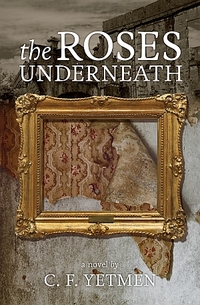
THE ROSES UNDERNEATH is the debut novel of C.F. Yetmen but you wouldn't know it when you read it. The story takes place in post World War II Germany. Anna Klein and her six year old daughter Amalia leave their home and Anna's husband Thomas, in Russia, for their own safety. They find there way to Anna's aunt's home and Anna gets a job in the typing pool working for the Americans at the Collecting Point warehouse. It is here that the Monuments Men work. The Men are there in Germany collecting and documenting the stolen artwork that the Nazis have taken for Hitler. When the men find out that Anna speaks English, she is recruited to help them as a translator. She meets Captain Cooper who has a habit of bending the rules but all for the good of his cause of recovering the stolen art. Anna forms an uneasy friendship with Cooper while working with him and strange things start to happen to them both.
As soon as you start reading THE ROSES UNDERNEATH you get a feel for how desperate things are for Anna. She has nothing. She brushes her teeth with her finger. Some mornings there is nothing to eat except lard. There is very little food in the city and most of the housing has been damaged from the bombs. So many of the citizens are displaced and one day while working with Cooper in a villa, they find a boy Oskar, who is guarding the huge piles of artwork they find in the basement. The can't leave the boy there so they take him to a displacement camp and promise to come back and check on him. Oskar plays a big part in THE ROSES UNDERNEATH but you have to read the book to find out what it is. I'm not giving anything away.
THE ROSES UNDERNEATH is not a book you will read and forget. It will stay with you long after you have finished. You will worry about Anna and find yourself cheering for her as she goes through her struggles and all the strange circumstances that keep happening to her. I love this book and it taught me so much about the Monuments Men and how they weren't stealing for themselves, but to get the art back to its owners and out of the hands of the Nazis. This is a quick read as I'm sure you will be flipping the pages as fast as I was to find out what happens to Anna, Amalia, Emil, and Captain Cooper. You will feel like you are right there along side of them thanks to C.F's attention to detail and history.
August 1945, Wiesbaden, Germany.
With the country in ruins, Anna Klein, displaced and
separated from her beloved husband, struggles to support
herself and her six-year old daughter Amalia. Her typing job
at the Collecting Point for the US Army's Monuments Men is
the only thing keeping her afloat. Charged with securing
Nazi-looted art and rebuilding Germany's monuments, the
Americans are on the hunt for stolen treasures. But after
the horrors of the war, Anna wants only to hide from the
truth and rebuild a life with her family.
When the easy-going architect Captain Henry Cooper recruits
her as his reluctant translator, the two of them stumble on
a mysterious stash of art in a villa outside of town.
Cooper's penchant for breaking the rules capsizes Anna's
tenuous security and propels her into a search for elusive
truth and justice in a world where everyone is hiding
something.
In her debut novel, C.F. Yetmen tells a story of loss and
reconciliation in a shattered world coming to terms with war
and its aftermath.
EXCERPT
Emerging on the Adolfsallee, they turned left toward the
Wiesbaden town center,
Amalia taking off in a half-skip, half-run. People were out
and about, beginning
daily tasks of cleaning, clearing rubble, finding food,
securing work or just
walking the streets in search of something. A line of
women—pails in hand—had
already formed where the milk truck sometimes appeared. The
Allied bombs had been
comparatively gentle on Wiesbaden, but that was just a
relative notion. Bombs were
bombs. Anna watched Amalia jump over holes in the sidewalk,
her green dress
bouncing in the dust clouds she kicked up. This is the
landscape of her childhood,
Anna thought. Mountains of rubble and rivers of blood. The
girl was only six and
had seen so much misery and stomached horrible fear, and
Anna worried that more was
to come. The war had been over for three months already, but
what had replaced it?
What were they living in? A sort of provisional purgatory,
she thought, with
occupiers who had to sort the bad from the good, the guilty
from the innocent, the
past from the future. We are damned; we unleashed hell on
the world. And now we
Germans must make good. She thought this every day. But to
make amends for
monstrosities perpetrated in your name and with your
complicity, even if it was
coerced? Was it even possible?
“Mama, look.” Amalia was pointing at something on the ground
and beckoning. As Anna
approached, she saw what had caught Amalia’s eye. Gleaming
in the sunlight was a
large metal button, the kind found on a Loden jacket or a
dirndl or some other
traditional dress, the kind the Nazis had been so fond of
the German Volk wearing.
It was heart-shaped and stamped with a scroll pattern. “Can
I take it?” whispered
Amalia, her eyes beaming as if she had found buried
treasure. Which, Anna thought,
she had, in a way.
“Yes, you may,” said Anna, joining in the spirit. “What a
prize.”
Amalia picked up the button, now black with grime and held
it on her flat palm.
“Can we wash it, Mama? So it will shine?”
“Yes of course, little Maus,” said Anna. “Now put it in your
pocket and keep it
safe. We need to hurry.”
Amalia slipped her hand into her mother’s and they walked on
between the piles of
stones that lay like sleeping prehistoric creatures along
the street. Anna imagined
them hibernating, waiting until they could be reanimated
into something new,
something hopeful. As they approached the Rheinstrasse, the
bustle of the city
flowed along the main thoroughfare and the Bonifazius church
glowed in the morning
sun, Gothic spires flanking its bombed out sanctuary like
two sentries. The
American MP directing traffic at the intersection whistled
and motioned for them to
cross. They turned and walked east into the sun, joining the
people heading to
whatever jobs they were lucky enough to have. Nearing the
large, looming
Landesmuseum, where the Americans had set up shop, they
walked along the newly
installed chain-link fence with the barbed wire on top until
they came to the guard
at the workers’ entry outside the rear courtyard. The sign
read U.S. Army
Monuments, Fine Art and Archives, and the young soldier
standing at the entrance
looked as earnest and rigid as a statue himself. Anna sat
Amalia down on a bench
next to the gate.
“Listen to me, Maus.” Anna squatted down. “Do you remember
what I said? You wait
here until I come out and get you. And what will you say if
anyone asks you why you
are here?”
Amalia exhaled and flatly recited the words: “My name is
Amalia Klein. My Mutter
ist Anna Klein. She ist in there. I wait for her?” She
pointed at the building.
“Mother, not Mutter,” said Anna, stroking the blond hair
that threatened to escape
from Amalia’s braids. “Mother.”
“Mother,” said Amalia. She pulled the button from her pocket
and studied it with
scientific intensity.
Anna’s stomach clenched. She wished she had some choice
other than leaving her
daughter here, on a bench on the sidewalk. But she didn’t.
“Look, Maus.” She
pointed at the GI. “See that American? I bet he comes from
Texas, from the Wild
West. Maybe he is the sheriff of his town and he has a big
horse and he keeps all
the bad guys away. That’s probably why he’s standing guard
here now. What do you
think?”
They stole a glance at the bulldog of a GI. His face was
young but worn and tired.
His white MP helmet was balanced precariously on his head,
which seemed too large
for his short, square body. The name on his uniform said
Long, which almost made
Anna smile.
“So he’s going to need your help keeping bad guys out of the
museum while Mama goes
to work.” Anna turned Amalia to face the three-story
building and pointed to the
top floor. “Count three windows from the end and that’s
where I’ll be. I’ll be
watching you all the time while I am doing my job. Your job
is to sit quietly
here.”
“But how long will you take, Mama?”
“Not long, only until lunchtime. Do you promise you won’t
move? You have Lulu to
keep you company.”
A pile of trash rained down from an upper window. GIs and
German workers dodged the
periodic showers of debris, old blankets, mattresses, pieces
of wood, and building
materials. These were the remnants of the hundreds of
displaced people who had
sought shelter in the museum at the end of the war. Now it
would house the new
offices of the Americans they called the Monuments Men. Anna
was not altogether
sure what their job was, it seemed to have something to do
with returning items to
people. But they had needed English speakers and typists and
to her great good
fortune, she was adept at both.










 © 2003-2026