Grand Central Publishing
Featuring: Jack Armstrong
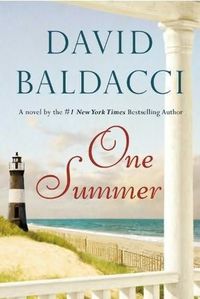
288 pages ISBN: 0446583146 EAN: 9780446583145 Kindle: B0048EKF0Y Hardcover / e-Book Add to Wish List
At age thirty-five, Jack Armstrong was diagnosed with a rare, aggressive form of cancer, a type that has no survivors. Jack was given six to eight months to live, and daily the pernicious disease took its toll. Jack's wish for his family is that he can hold on until Christmas, which is just a few days away. He begins writing letters to his adored and beloved wife, Lizzie, as a gift for her after he is gone. He wants her to know how much he has always loved her and will always love her. All five of the letters he has written thus far are upbeat and pleading with her to get on with her life. Jack and Lizzie have three children, fifteen-year-old Michelle, who is getting more rebellious every day, and two boys, ages ten and three. On Christmas Eve tragedy strikes the Armstrong family, but it isn't Jack's demise -- Lizzie is killed in an automobile accident.
Jack's in-laws take the children and leave Jack alone to die in a hospice facility. When Jack's life support systems are removed, nothing happens. Daily he begins to get better, and his doctor decides it is truly a miracle since there is not a case on file that remission has happened; much less all trace of the cancer disappearing. With the help of his best friend and co-worker, Jack builds his strength, mind, and body back to normal, claims his children, and they all resettle in South Carolina at the home where Lizzie lived as a child.
David Baldacci writes magnificent tales of political intrigue and now has written a young adult novel. While ONE SUMMER does not qualify as a romance, it is truly an extraordinary love story. The characters are people you want to meet, and the dialogue is exceptional. This character driven story is beautiful and highly emotional. It is this reviewer's hope that Mr. Baldacci will continue spreading his talents into genres other than the one that has made him "rich and famous." This book comes highly recommended.
When Jack Armstrong is told he has a terminal illness and
that he has weeks to live, his first concern is for his
beloved wife, Lizzie, and children, baby Jack, Cory and
rebellious teenager Mikki. On Christmas Eve, when Lizzie
comes home, Jack is devastated to see his neighbor, Bill
Miller, kiss Lizzie on their driveway. Jack confronts her,
she tries to explain he's got it all wrong, and
distraught, she leaves the house into an ice storm - and a
fatal collision with a truck. Overwhelmed with grief, and
with his illness worsening Jack is taken into a hospice.
The children move to the West Coast to live with various
members of the family.
But then a miracle happens. Jack begins to recover, and
day by day he starts to heal. Confounding the doctors,
Jack leaves the hospital without any evidence of the
illness. Unexpectedly the family inherits a beautiful old
villa with a lighthouse on the beach in South Carolina. It
was the house where Lizzie grew up and Jack feels an
inexplicable closeness to her while he's there. Although
his mother-in-law, Bonnie, has other ideas for their
future, Jack knows that this is the chance he has to re-
build his relationship with his kids. And as he struggles
to reconnect with the children, he also has the chance to
find love again, perhaps even with Lizzie's help.
EXCERPT
Jack Armstrong sat up in the secondhand hospital bed that
had been wedged into a corner of the den in his home in
Cleveland. A father at nineteen, he and his wife, Lizzie, had
conceived their second child when he’d been home on leave
from the army. Jack had been in the military for five years
when the war in the Middle East started. He’d survived his
first tour in Afghanistan and earned a Purple Heart for taking
one in the arm. After that he’d weathered several tours of duty
in Iraq, one of which included the destruction of his Humvee
while he was still inside. That injury had won him his second
Purple. And he had a Bronze Star on top of that for rescuing
three ambushed grunts from his unit and nearly getting killed
in the process. After all that, here he was, dying fast in his
cheaply paneled den in Ohio’s Rust Belt.
His goal was simple: just hang on until Christmas. He
sucked greedily on the oxygen coming from the line in his
nose. The converter that stayed in the corner of the adjacent
living room was on maximum production, and Jack knew one day
soon it would be turned off because he’d be dead. Before
Thanksgiving he was certain he could last another month.
Now Jack was not sure he could make another day.
But he would.
I have to.
In high school the six- foot- two, good- looking Jack had
varsity
lettered in three sports, quarterbacked the football team,
and had his pick of the ladies. But from the first time he’d
seen Elizabeth "Lizzie" O’Toole, it was all over for him in the
falling-in-love department. His heart had been won perhaps
even before he quite realized it. His mouth curled into a smile
at the memory of seeing her for the first time. Her family had
come from South Carolina. Jack had often wondered why the
O’Tooles had moved to Cleveland, where there was no ocean,
a lot less sun, a lot more snow and ice, and not a palm tree in
sight. Later, he’d learned it was because of a job change for
Lizzie’s father.
She’d come into class that first day, tall, with long auburn
hair and vibrant green eyes, her face filled out and lovely.
They
had started going together in high school and had never been
separated since, except long enough for Jack to fight in two
wars.
"Jack; Jack honey?"
Lizzie was crouched down in front of him. In her hand was
a syringe. She was still beautiful, though her looks had taken
on a fragile edge. There were dark circles under her eyes and
recently stamped worry lines on her face. The glow had gone
from her skin, and her body was harder, less supple than it had
been. Jack was the one dying, but in a way she was too.
"It’s time for your pain meds."
He nodded, and she shot the drugs directly into an access
line cut right below his collarbone. That way the medicine
fl owed directly into his bloodstream and started working
faster. Fast was good when the pain felt like every nerve in his
body was being incinerated.
After she finished, Lizzie sat and hugged him. The doctors
had a long name for what was wrong with him, one that
Jack still could not pronounce or even spell. It was rare, they
had said; one in a million. When he’d asked about his odds of
survival, the docs had looked at each other before one finally
answered.
"There’s really nothing we can do. I’m sorry."
"Do the things you’ve always wanted to do," another had
advised him, "but never had the chance."
"I have three kids and a mortgage," Jack had shot back,
still reeling from this sudden death sentence. "I don’t have the
luxury of filling out some end-of-life bucket list."
"How long?" he’d finally asked, though part of him didn’t
really want to know.
"You’re young and strong," said one. "And the disease is
in its early stages."
Jack had survived the Taliban and Al-Qaeda. He could
maybe hold on and see his oldest child graduate from college.
"So how long?" he’d asked again.
The doctor said, "Six months. Maybe eight if you’re lucky."
Jack did not feel very lucky.
He vividly remembered the morning he started feeling
not quite right. It was an ache in his forearm and a stab of
pain in his right leg. He was a building contractor by trade,
so aches and pains were to be expected. But things soon carried
to a new level. His limbs would grow tired from three
hours of physical labor as opposed to ten. The stabs of pain
became more frequent, and his balance began to deteriorate.
His back finally couldn’t make it up the ladder with the stacks
of shingles. Then it hurt to carry his youngest son around
after ten minutes. Then the fire in his nerves started, and his
legs felt like an old man’s. And one morning he woke up and
his lungs were like balloons filled with water. Everything had
accelerated after that, as though his body had just given way
to whatever was invading it.
His youngest child, Jack Jr., whom everyone called Jackie,
toddled in and climbed on his dad’s lap, resting his head
against his father’s sunken chest. Jackie’s hair was long and
inky black, curled up at the ends. His eyes were the color of
toast; his thick eyebrows nearly met in the middle, like a burly
woolen thread. Jackie had been their little surprise. Their two
other kids were much older.
Jack slowly slid his arm around his two-year-old son.
Chubby fingers gripped his forearm, and warm breath touched
his skin. It felt like the pierce of needles, but Jack
simply gritted
his teeth and didn’t move his arm because there wouldn’t
be many more of these embraces. He slowly turned his head
and looked out the window, where the snow was gently falling.
South Carolina and palm trees had nothing on Cleveland
when it came to the holidays. It was truly beautiful.
He took his wife’s hand.
"Christmas," Jack said in a wheezy voice. "I’ll be there."
"Promise?" said Lizzie, her voice beginning to crack.
"Promise."




 © 2003-2026