"Sometimes it's downright impossible to tell the good guys from the bad"

Reviewed by Sandra Wurman
Posted September 13, 2010
Romance
Libby Brown is just sick and tired of men. All men. Working as a big city journalist has its rewards but her life -- most especially her love life -- has taken the joy out of even the best career accomplishments. So pulling herself up by her bootstraps, literally and figuratively, she sets out to follow another dream of hers which is to own a farm. She envisions her farm to be just like the Fisher Price one she had as a child but reality just keeps bursting her bubble.
First she gets to her farm -- chicken farm she has decided -- and it is beyond rundown. Actually rundown would be an improvement. But pretty soon her baby chicks, and a cache of dogs, arrive. Soon, Libby finds herself adapting well to her new farmer role. However, as luck would have it, she stumbles on the mysterious disappearance of a local teenager, that after two years is still no closer to being solved. This is just the kind of case that could help launch her career as a reporter for the local newspaper. Unfortunately, this may be a story that someone would just as soon stay untold.
While digging for answers, Libby finds herself in one mess after another but, not to worry, hunky rancher neighbor Luke is somehow always there to get her out of trouble. But that in itself is trouble for Libby who is not looking for any emotional or physical entanglements, even though there's no denying her attraction to Luke. And then there's the journalist side of her that is getting disturbing vibes from his attentiveness. As time goes on the cast of suspects seems to grow and the most likely of them are locals who seem eager to befriend Libby. The line between friend and suspect is becoming fuzzy as her life and peace is threatened. It's rapidly becoming a race between good and evil. And as her relationship with Luke grows into something resembling love, Libby is faced with a real possibility that Luke might hold the key to the teenagers disappearance. Once again she is faced with a question of trust. Surely Luke can pass the test...or can he?
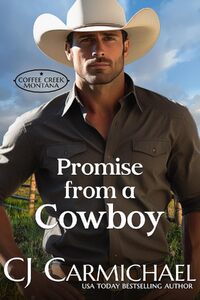
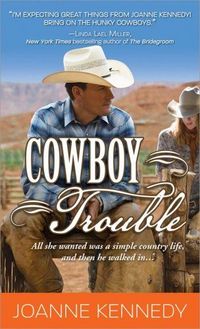
Never judge a book by its cover especially holds true for COWBOY TROUBLE. Just when you think this is going to be another girl meets rancher story, Kennedy throws a wrench in the mix and not just one -- a whole toolbox of them. This book definitely had me questioning my sleuthing skills by the end, so sure that I knew exactly who the culprit was. Kennedy had me believing that there wasn't a good guy in the bunch. Enjoy. SUMMARYFleeing her latest love-life disaster, big city journalist
Libby Brown’s transition to rural living isn’t going
exactly as planned. Her Wyoming ranch and its picturesque
outbuildings are falling to pieces all around her. So is
her resolution to live a self-sufficient, independent life–
thanks to the irresistible allure of her neighbor’s fringed
leather chaps.
Handsome rancher Luke Rawlins is impressed by this sassy,
independent city girl. But he yearns to do more than help
Libby with her ranch. He’s ready for love, and he wants to
go the distance.
Then the two get embroiled in their tiny town’s one and
only crime story, and Libby discovers that their sizzling
hot attraction is going to complicate her life in every way
possible...
EXCERPTChapter 1
A chicken will never break your heart.
Not that you can’t love a chicken. There are some people
in this world who can love just about anything.
But a chicken will never love you back. When you look
deep into their beady little eyes, there’s not a lot of
warmth there—just an avarice for worms and bugs and, if
it’s a rooster, a lot of suppressed anger and sexual
frustration. They don’t return your affection in any way.
Expectations, relationship-wise, are right at rock-
bottom.
That’s why Libby Brown decided to start a chicken farm.
She wanted some company, and she wanted a farm, but she
didn’t want to go getting attached to things like she had
in the past.
She’d been obsessed with farms since she was a kid. It
all started with her Fisher Price Farmer Joe Play Set: a
plastic barn, some toy animals, and a pair of round-headed
baby dolls clutching pitchforks like some simple-minded
version of American Gothic.
A Fisher Price life was the life for her.
Take Atlanta—just give her that countryside.
###
Libby had her pickup half unloaded when her new neighbor
showed up. She didn’t see him coming, so he got a prime
view of her posterior as she bent over the tailgate,
wrestling with the last of her chrome dinette chairs. The
chair was entangled in the electric cord from the toaster,
so he got a prime introduction to her vocabulary, too.
"Howdy," he said.
Howdy? She turned to face him and stifled a snort.
Halloween was three months away, but this guy was ready
with his cowboy costume. Surely no one actually wore chaps
in real life, even in Wyoming. His boots looked like the
real thing, though; they were worn and dirty as if they’d
kicked around God-knows-what in the old corral, and his
grey felt Stetson was all dented, like a horse had stepped
on it. A square, stubbled chin gave his face a masculine
cast, but there was something soft about his mouth that
added a hint of vulnerability.
She hopped down from the tailgate. From her perch on the
truck, he’d looked like the Marlboro Man on a rough day,
but now that they were on the same level, she could see he
was kind of cute—like a young Clint Eastwood with a little
touch of Elvis.
"Howdy," he said again. He actually tipped his hat and
she almost laughed for the first time in a month.
"I’m Luke Rawlins, from down the road," he continued.
The man obviously had no idea how absurd he looked, decked
out like a slightly used version of Hopalong
Cassidy. "Thought maybe you’d need some help moving in. And
I brought you a casserole—Chicken Artichoke Supreme. It’s
my specialty." He held out a massive ceramic dish with the
pride of a caveman returning from the hunt. "Or maybe you
could use a hand getting that chair broke to ride."
Great. She had the bastard son of John Wayne and Martha
Stewart for a neighbor. And he thought he was funny.
Worse yet, he thought she was funny.
"Thanks." She took the casserole. "I’m Libby Brown. Are
you from that farm with the big barn?"
"Farm? I’m not from any farm." Narrowing his eyes, he
slouched against the truck and folded his arms. "You’re not
from around here, are you?"
"What makes you say that?"
"You calling my ranch a farm, that’s what." A blade of
wheatgrass bobbed from one corner of his mouth as he looked
her up and down with masculine arrogance. "There’s no such
thing as a farm in Wyoming," he said.
"Well, what do you call this, then?" Libby gestured
toward the sun-baked outbuildings that tilted drunkenly
around her own personal patch of prairie.
"A ranch."
"That’s not what I call it. I call it ‘Lackaduck Farm’."
She pointed to the faded letters arched over the barn’s
wide double doors. "That’s what the people before me called
it, too. It’s even painted on the barn."
"Yeah, well, they weren’t from around here, either. They
were New Yorkers, and got smacked on the bottom and sent
home by Mother Nature. Thought they’d retire out here on
some cheap real estate and be gentleman farmers. They
didn’t realize there’s a reason the real estate’s cheap.
It’s tough living." He looked her in the eye, no doubt
judging her unfit for a life only real men could
endure. "You think you’re up to it?"
"As a matter of fact, I am." Libby hoped she sounded a
lot more confident than she felt. "This is what I’ve always
wanted, and I’m going to make it work."
She didn’t mention the fact that she had to make it
work. She didn’t have anything else. No career—not even
much of a job. And no boyfriend. Not even a dog.
The dog died last year, right before the boyfriend ran
off. Lucky couldn’t help it, but Bill Cooperman could have
stuck around if he’d only tried. He just had a wandering
eye, and it finally wandered off for good with a hotshot
editor from the Atlanta Journal-Constitution. The hotshot
editor was also Libby’s boss, so she basically lost
everything in the space of about six weeks. All she had
left was a broken heart, a cherry-red pickup, and the
contents of her desk in a battered cardboard box.
Since her professional and romantic aspirations were a
bust, she’d sold her one-bedroom condo in downtown Atlanta
and literally bought the farm. She was now the proud owner
of thirty-five acres of sagebrush and a quaint clapboard
farmhouse in Lackaduck, Wyoming. At the moment, tumbleweeds
were her primary crop and grasshoppers her only livestock,
but the place was as far from Atlanta as she could get, and
she figured a fresh coat of paint and a flock of free-range
chickens would make it her dream home—one utterly unlike
the one she’d left behind. So far, Wyoming was like another
planet, and that was fine with her.
"I’m definitely going to make this work," she repeated,
as much to herself as to her new neighbor.
The cowboy reached over the truck’s battered tailgate
for the dinette chair, which freed itself from the toaster
cord the minute he touched it.
"Guess you’ll be glad to get some help, then."
He swung the chair over his shoulder and headed for the
house.
Libby sighed. She had her pride, but she wasn’t about to
turn her bad back on an able-bodied man who was willing to
tote furniture for her. Beggars can’t be choosers, and Luke
Rawlins wasn’t really such a bad choice, anyway. She wasn’t
in the market for his brand of talent, but it sure was fun
to watch him move furniture. Those chaps, with their
swaying leather fringe, must have been designed by the
early cowboys to highlight a man’s best assets.
To be continued...
BOOK SERIES
| 




 © 2003-2026