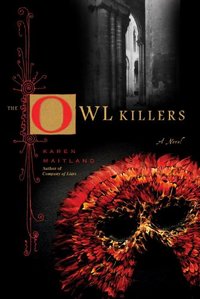
The village of Ulewic (the place of the owl in Old English) had a difficult year with crops, animal disease and flooding in 1321. But a community of women living outside the village didn't suffer the same damage to plants and animals. The women in these communities, called beguines, lived an austere and religious life without being nuns. They had the freedom to make choices and cared for the sick and hungry in the village. The women rarely turned people away including individuals cast out by the villages. Rumors also ran rampant that the women practiced evil sexual acts amongst themselves.
Whether from fear, revenge, or in search of an easy scapegoat, the Owl Masters, who held with ancient pagan traditions and rituals, blamed the women for the village's troubles. The Owl Masters ruled the village, and the villagers knew it and feared them more than any punishment from the lord or Church. After all, the priest, Father Ulfrid, wouldn't burn a man alive for sleeping with a maid already promised to another man. The manor lord, Robert D'Acaster, and Father Ulfrid hold secular and religious posts at the whim of, or at least with oversight, of the Owl Masters.
The story revolves around the Owl Masters revenge against the beguinage, and the women's response. The author includes sub-plots throughout the story, introducing the reader to numerous well-drawn characters: Beatrice, a beguine obsessed with having her a child of her own; Agatha/Osmanna, the youngest daughter of D'Acaster who becomes a beguine; Pisspuddle, a young village girl who covets a spot with the tumblers who come to every May Day celebration; and Father Ulfrid, the village priest who has some of his own skeletons hidden in his closet.
Karen Maitland draws the reader back nearly 700 years in this tale of religion, mystery and evil, but it might as well be yesterday with the ease with which she recreates this village of long ago. While Maitland tells us that Ulewic itself is a fictionalized village, many villages of its kind dotted the English coast, and 1321 was a bad year for drought and animal sickness. Beguinages had cropped up throughout the Netherlands and Belgium and while some had traveled to England, none survived long. With exquisite and vivid descriptions, lyrical prose and complex characters, Maitland brings history to life. You can almost hear the pulsing of ritual drums and feel the branches lash at your face in the forest in the midst of a storm.
No excerpt available.







 © 2003-2026