You don't come across a lot of sympathetic portraits of Catherine de Medici. She's generally thought of as one of the great villainess of history. Blamed for the St. Bartholomew's Day Massacre, Catherine also is remembered for her fondness for poisons and as a dabbler in sorcery.
As a woman of the 16th century, Catherine was the pawn of men and politics. Like all women of the time, she was bound by God, duty, the law and her father to be used in whatever way circumstance warranted. As the wife of a king and the mother of three others, Catherine enjoyed power and privilege. As an outsider in the French court, she was humiliated by her husband and his mistress and lived in an age of treachery and political intrigue where assignation was a very real threat.
Kalogridis presents a Catherine, or Caterina, who loves her husband and children and is determined to protect her family and her sons' birthrights no matter the consequences. To Catherine, the end always justifies the means. To the casual reader, the events of history seem to be well-researched. Still, I was bored by the narrative, at times. The story didn't draw me in. I much preferred the more melodramatic potboilers that Jean Plaidy wrote about Catherine decades ago which I remember as being a lot more lively.
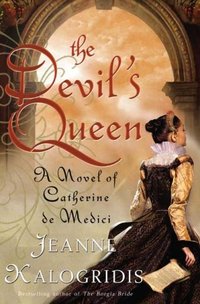
From Jeanne Kalogridis, the bestselling author of I,
Mona Lisa and The Borgia Bride, comes a new
novel that tells the passionate story of a queen who loved
not wisely . . . but all too well.
Confidante of
Nostradamus, scheming mother-in-law to Mary, Queen of
Scots, and architect of the bloody St. Bartholomew’s Day
Massacre, Catherine de Medici is one of the most maligned
monarchs in history. In her latest historical fiction,
Jeanne Kalogridis tells Catherine’s story—that of a tender
young girl, destined to be a pawn in Machiavellian games.
Born into one of Florence’s most powerful families,
Catherine was soon left a fabulously rich heiress by the
early deaths of her parents. Violent conflict rent the
city state and she found herself imprisoned and threatened
by her family’s enemies before finally being released and
married off to the handsome Prince Henry of France.
Overshadowed by her husband’s mistress, the
gorgeous, conniving Diane de Poitiers, and unable to bear
children, Catherine resorted to the dark arts of sorcery
to win Henry’s love and enhance her fertility—for which
she would pay a price. Against the lavish and decadent
backdrop of the French court, and Catherine’s blood-soaked
visions of the future, Kalogridis reveals the great love
and desire Catherine bore for her husband, Henry, and her
stark determination to keep her sons on the throne.













 © 2003-2026