Chapter One
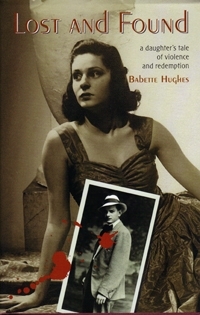
I have a blurred mental image of my mother coming home from
my daddy's funeral. She is wearing a veiled black hat that
scares me. I am two years old and had been left at home, put
to bed for my nap by a big colored lady. But I can't sleep.
The house feels too quiet. Something big is wrong. I stand
up in my crib and scream. No one comes.
Finally I am taken downstairs. Grown-ups
in dark clothes are standing around whispering. There is the
cloying smell of sweet pastries, the sound of china; ladies
in aprons are busy in the kitchen. One of them gives me a
cookie. She is crying. I have never seen a grown-up cry
before and I start to wail. A man picks me up; his face
feels scratchy. I scramble down and look for my mother.
I see her sitting in a big chair and run
to her. She pulls me onto her lap. I tug at the black veil
knocking off her hat but, still, I cannot stop crying.
"Babette, honey, shh, don't cry, it's all right," she
murmurs. I feel her heart pound through my dress and,
weeping, hang onto her until someone wipes my runny nose and
pulls me away.
My mother sits quietly in the big chair listening to the
noises of the kitchen and the murmur of the mourners'
voices. Hearing a piercing screech she thinks it came from
her own mouth. But no one turns to her and she realizes it
was a screaming tea kettle. She stares at the mourners in
their dark clothes and sorrowful faces as they move about
the dining room table laden with platters of herring, smoked
whitefish, smoked salmon, cream cheese, hard-boiled eggs,
bagels and Kaiser rolls. Home-made sponge cake, macaroonsand
fig newtons, baked by the ladies in the kitchen while her
husband was being buried.
Upstairs, my daddy's suits hang limply
with their empty sleeves, neatly arranged by color and
season, the dark blues and grays giving way along the rack
to the summer creams and whites. Shallow drawers hold rows
of jeweled cuff links, a rainbow of ties stretches along a
wall, and dozens of stiff-collared silk shirts hang neatly
in whites and pastels.
Now the mourners are filling the large,
proud living room after first washing their hands from the
pitcher on the front stoop. (Someone had set up the ancient
Jewish funeral ritual as if this were a benign death and you
could wash off the wreckage.) My mother looks around for my
brother, a tow-headed blue-eyed boy of six, but he has
already escaped into the backyard our daddy had equipped
with swings, jungle gyms, even a child-sized car. Peering
through the window she sees him riding his car on the hard,
gray snow, his correct little tie off and already a rip in
the scratchy suit jacket bought especially for his father's
funeral.
Earlier, at the burial, he had dutifully
thrown a small handful of dirt into the freshly dug grave as
the rabbi muttered the Kaddish. I see him there in the
shimmer of a dream and imagine heat rays emanating from the
open grave like the disturbed air of hell. Suddenly my
mother's knees buckle under her. The funeral director with
his neat, black suit and blank eyes reaches out and steadies
her with the expressionless efficiency of his profession,
corpses and collapsing widows as unremarkable to him as an
accountant's pencil and adding machine. Her dizziness is
actually due to the pill given her by a Dr. Magio who is
said to be kept on a retainer for the time a bullet or two
has to be discreetly removed, and who was called when my
mother was unable to stop screaming. She feels shame in her
near-collapse and extravagant sorrow—mixed as it is with a
curious and confusing measure of relief that Lou Rosen's
vitality and violence are now subdued six feet under. She is
only 27 after all, her flesh still young, her thighs still
slender and surely not meant never to open to a man again.
But if she imagines freedom and options
with a pounding heart she learns soon enough that the dead
do not leave. Even without the lingering scent of his
after-shave, the damp towel across the bed, the diamond
stick pin and gold cuff links on the bedside table, Lou is
an ongoing gauzy presence, everywhere and nowhere, hovering
over her, over all of us.
Now, sitting in the living room, my
mother watches a group of three men as they enter her house
and hang up their coats and fedoras on the racks provided by
the Berkowitz Funeral Home. She knows that the big man, the
one with the drooping eyelids and heavy glasses, ordered her
husband's murder—she wonders if the two men with him were
the actual killers. She also knows that the hundreds of
white carnations and roses covering his casket were sent by
their polite murdering hands. But she is not afraid; she has
been a bootlegger's wife long enough to know that as long as
they keep their silence widows and children are sacrosanct.
She has been a bootlegger's wife long enough to understand
the code; no one will harm her unless, of course, she breaks
it and reveals his name, which she knows to be Joe Lonardo,
the Cleveland Mafia boss who is now offering his clean hand
to her in solemn-faced sympathy. She shakes his hand and
feels her stomach rise to her throat. She is afraid she will
vomit on his wingtips.
The rabbi in his black suit and beard and
woeful expression is standing with Marvin, brother of the
deceased. Marvin has thick black hair that looks windblown,
or mussed from making love. Talking to the rabbi, gesturing
with his hands, he is smiling as if he's at a wake with
believers of an afterlife, even for Lou Rosen. The rabbi is
eating a wedge of sponge cake. He wipes his mouth with a
dinky embroidered napkin. There are crumbs in his beard. He
puts his empty plate down on the grand piano, straightens
his
yarmulke, and crosses the room to my mother. He
leans over and kisses her on the cheek; she feels his beard
brush her face and has an impulse to grab hold of it. She
feels like laughing and has to duck her head and hold her
handkerchief to her mouth.
"Mrs. Rosen—are you all right?" the rabbi
asks. His voice is deep, concerned.
She nods. She even smiles. She wonders if
she is going crazy. Although the rabbi is older than she by
at least a decade, she thinks he is too young to have
anything to say to her. She wants him to go away, to leave
her alone. But he sits down in a chair at her side, looks
into her eyes and speaks. What? What did he say? She is too
preoccupied to hear. She wants to ask him if her husband
killed anyone before he was killed; if God had punished him,
an eye for an eye. She wants to ask him if a bootlegger can
get into heaven. Or a bootlegger's wife, for that matter.
She wants to ask him if there is a heaven. She wants to ask
him if there is a God. Foolish woman! Not a question for a
rabbi. But the truth is she receives little comfort from his
respectful attendance or his pieties or from the funeral
service or the Kaddish her son, a child of six, had
dutifully repeated in a clear child's voice at graveside,
and has no hope of heavenly intervention into the life she
has already found to be absurd. Sitting there, receiving
condolences, she feels that God is unaware of her small
mistaken existence and that it would be dangerous to get the
attention of such a capricious deity who maybe has it in for
orphan girls who get mixed up with gangsters. So she says
nothing as the rabbi rises to leave, lowering her eyes and
retreating into the hushed respect reserved for the newly
widowed.
She notices her mother sitting across the
room. When did she come in? Anna Wolf (Wolf being her second
husband, now dead, who was said to have given her the
syphilis that eventually killed her) is sitting on the couch
with her purse on her knees. She has good bones, the same
good bones as my mother, her face is sculptured like an
aristocrat's, and with her haughty bearing, could have been
reincarnated from a former blue-blooded life. She is
daintily eating a cookie with her pinky finger held aloft,
sipping from her cup as if she were at a tea party. Now she
puts the cup down on the coffee table, opens her purse,
retrieves a mirror and tube of lipstick, and carefully
applies it to her thin mouth with her reddened arthritic
fingers. I do not like the feel of my grandmother's dry
rough hands on my skin.
Anna's first husband was Jacob Smith, the
name changed from Schmitko when he emigrated to Cleveland
from Poland. But his new Americanized name and youth, his
grand handlebar mustache and his young wife couldn't protect
him from the tuberculosis epidemic—known in those days as
consumption. He died at the age of thirty after a long
illness leaving Anna with nothing but four children, a
meager grocery store, and her own cold heart.
Tending to her few customers, she left
her small daughters to the streets of the Scovil Avenue
neighborhood. That is, until the day a neighbor paid a visit
to the authorities and reported Anna Smith's appalling
neglect of her three little girls, who, dirty and hungry,
had been running wild in the neighborhood for weeks, months.
My mother, Florence, was 3; her sisters, Lillian and Mabel,
5 and 7.
Soon after, a high-bosomed woman and a
man with a walrus mustache and a watch chain showed up at
Anna's grocery store. She led them upstairs to her rooms,
telling her daughters to wait outside. They sat down
obediently on the stoop in their grimy, torn dresses. A
peddler passed, rattling his cart filled with pots and pans.
It was July, and the air smelled of garbage, urine and the
cabbage from someone's kitchen. A baby was crying overhead
and a woman leaned out of her window calling to her son, who
was nowhere in sight. After awhile, the man emerged folding
papers into his breast pocket. He nodded to the woman
waiting on the stoop with the children and one at a time she
lifted the three ragged girls into the wagon. (Della, too
young at six months to be taken, was left upstairs with
Anna.) Florence, my mother, started to scream as if she was
the only one who understood what was happening, setting off
her sisters. The woman reached in her bag and gave each
weeping child a small lollipop. Even though their mother had
a grocery store and a glass jar of penny candy stood on the
dusty shelf, they were never given any, and they stopped
crying, tore off the wrapper and began sucking greedily. The
man and woman climbed into the wagon as the neighbors stared
through their windows; the man jiggled the horse's reins,
and it disappeared, rattling down the cobblestone street.
In my sentimental imagination I picture
Anna running after the horse and wagon, arms outstretched.
tears streaming down her face, crying. My babies! My babies!
Like in a silent movie. Like Charlie Chaplin and Jackie
Coogan in
The Kid. But I know better. What I know of
Anna is that she turned away to wait on a customer. Or
simply stood watching them leave from her window.
When they arrived at the Jewish Orphan
Asylum on Woodland Avenue and 55th street, a smell of rot
rose from the earth. The sisters stared at the high
iron-spiked fence that surrounded the large buildings, the
barred windows and the ragged children watching them from
the playground. Sobbing in fear, they eyed still another
frightening stranger come toward them on this bewildering
morning. Later they would learn that he was Dr. Sam
Wolfenstein, the director, whom they would come to regard
with fear and awe as a surrogate for God himself, with his
heavy beard and bushy eyebrows, weekly sermons, strict
discipline and constant admonitions about the moral life.
"Now, now," he said, lifting my mother,
the smallest, out of the wagon. "You'll have to stop that
crying."
But she didn't. She was three years old
but she knew that something very bad was happening; the
disappearance of her mother, her lollipop and her freedom
all tangled together into a confusing sense of terrifying
loss. She couldn't stop crying. She could not.
"Hush!" he said, louder.
But his shouts only brought forth a fresh
cascade of screams.
"Stop it! This minute!" he shouted,
unused to being disobeyed by his orphans. He held her small,
dirty, screaming self at arms-length like a bad-smelling,
noisy, squirming chicken and handed her to the woman from
the wagon. As she took their screaming baby sister away,
Mabel and Lill watched wide-eyed, their terror and confusion
striking them mute.
The sisters were then separated into
their respective age groups among the other 500 "inmates"
(as they were called in their lives behind bars) enduring
yet another loss—this time of each other.
My mother was taken to a large damp room
in the basement (infested, like the orphanage's other
nineteenth-century buildings, with huge rats, lice and
bedbugs). Staring with alarm at the large pool of green
water with two ladders leading down into it, she was
stripped and examined for lice. The probing of her head and
body by yet another stranger set her off again into a
rejuvenated fit of wailing until she was dragged into the
tub and shocked into silence by the scalding water. Alter
being scrubbed by one of the older girls, her hair was cut
off—setting off a lifelong preoccupation with her hair.
(Over the years, following the Fashion of the day, she had
it bobbed, upswept, permed, straightened, marcelled,
streaked, layered.)
Scrubbed, de-loused, and shorn, exhausted
and subdued, she was now put into thick, gray undergarments
with long legs that itched winter and summer. Black
stockings went on next, then a red flannel underskirt and
finally a dress of wool that reached the ankles. Over that
went a blue striped apron. Shoes were made of thick leather
that laced up over the ankles. After being dressed she was
assigned a number that was sewn on her uniform and by which
she was henceforth known.
She was always hungry. While doing her dawn-to-dusk-chores,
during her hours of Hebrew and Bible study, she was hungry.
Attending classes in German, English and mathematics,
history, social studies and geography, penmanship and
spelling, she was hungry. Sitting among the five hundred
other orphans at long wooden tables often in enforced
silence, there was never enough to eat, and for every hour
of each and every day, for the next twelve years, she was
hungry.
But she was also smart, every year
performing academically at the top of her class. And at the
age of fifteen, on a lovely June afternoon in 1912, my
mother graduated valedictorian from the Jewish Orphan Home.
After the ceremonies, her Hebrew teacher,
Mrs. Adler, climbed the stairs to her dorm where my mother
was packing her few belongings. "You're to go to the
office," she told her.
Clutching her valedictorian medal, she
ran downstairs. Mrs. Goldstein, the secretary, was standing
in the administration office with a woman Florence had never
seen before.
"This is Anna Smith," Mrs. Goldstein
said. "She is your mother." Florence stared at the stranger
standing there in a brown coat and feather-trimmed hat. Anna
Smith had never visited her daughters. Not once. Not once in
12 years.
But my mother went home with Anna—where
else could she go? Her older sisters, Mabel and Lill, had
preceded her, and their small apartment was so crowded the
last one home had to sleep on the floor and the second one
up in the morning got the last of the two pairs of silk
stockings they owned among them.
Although Anna hadn't showed up at the Home, she came to the
house after the funeral that day, sitting silently and
drinking her tea and applying lipstick with the monumental
indifference her daughter envied but could not, for the life
of her, emulate. Her own passions had led her from the
orphan's cloistered world to the bootlegger's life, and she
might have looked at her strange mother receiving polite
condolences with wonder and rage. Growing up, I heard her
cheerfully, guiltlessly and frequently announce that she
hated her mother. Which embarrassed me. It made me nervous.
You just weren't supposed to say you hated your own mother.
And yet she was a dutiful daughter, taking her in to live
with us during the Depression, giving her money at no small
sacrifice, going on streetcars to visit her in bitter cold
weather after she moved out. I guess she was still trying to
have a mother. Even Anna.










 © 2003-2026