
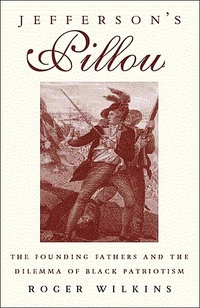
Purchase
The Founding Fathers and the DIlemma of Black Patriotism
Beacon Press
July 2002
On Sale: July 12, 2002
163 pages
ISBN: 0807009571
EAN: 9780807009574
Paperback
Add to Wish List
Non-Fiction History
An outspoken participant in the civil rights movement, Roger Wilkins served as Assistant Attorney General during the Johnson administration. In 1972 he was awarded the Pulitzer Prize along with Bernstein and Herblock for his coverage of Watergate. Yet this black man, who has served the United States so well, feels at times an unwelcome guest here. In Jefferson's Pillow, Wilkins returns to America's beginnings and the founding fathers who preached and fought for freedom, even though they owned other human beings and legally denied them their humanity. He asserts that the mythic accounts of the American Revolution have ignored slavery and oversimplified history until the heroes, be they the founders or the slaves in their service, are denied any human complexity. Wilkins offers a thoughtful analysis of this fundamental paradox through his exploration of the lives of George Washington, George Mason, James Madison, and of course Thomas Jefferson. He discusses how class, education, and personality allowed for the institution of slavery, unravels how we as Americans tell different sides of that story, and explores the confounding ability of that narrative to limit who we are and who we can become. An important intellectual history of America's founding, Jefferson's Pillow will change the way we view our nation and ourselves. "We are obliged to judge because we are obliged to do better; to probe the flaws of our predecessors is to engage not in vindictive finger-pointing but to resist hubris and complacency in our own time. Wilkins' book has made a mirror of the past in which we glimpse our own shortcomings —and perhaps even the means for transcending them." —Philip Connors, In These Times (full review online) "Wilkins makes a case for his opinions in sentences that enchant and inform. In its persuasive blend of logic and lyricism, Wilkins's language at its most potent is positively . . . Jeffersonian." —Jabari Asim, Washington Post Book World (full review online) With a sense of genuine curiosity Wilkins tried to avoid either condemning the founders too easily by modern standards or excusing too easily the contradictions of their slave ownership. Instead, by exploring the culture and atmosphere in which they grew up, he discovered how much slavery was an integral part of the Virginia society that enabled the founders to create the recipe for modern rights, equality and democracy. —Clarence Page, Chicago Tribune (full article online) "Wilkins, who describes himself as a 'deeply committed American,' is never less than a patriot here; someone indifferent about America could not write such a thoughtful book. He demythologizes the Founding Fathers, yet expands their greatness by placing it within the context of the times, as well as their flawed humanity." —Boston Globe "When the Founding Fathers were deciding whether to risk their lives and fortunes for their ideals, Benjamin Franklin remarked: 'We must all indeed all hang together, or most assuredly we shall hang separately.' In the years after their bold gamble for freedom, the hangman's noose played a far darker role in our republic, becoming the lynch mob's weapon of choice for denying African-Americans their inalienable rights. Liberty and freedom, repression and racism, these warring yet braided strands form the Gordian knot of the American experience: A land of visionary light entwined in the darkest recesses of human cruelty. Now comes Roger Wilkins like a modern-day Alexander to cut this knot." —J. Peder Zane, Raleigh News and Observer "This astonishing book by the 1980s antiapartheid leader Wilkins (a professor of history at George Mason University and Pulitzer-Prize winner) provides a brief, but tremendously incisive demythologizing of four Virginian founders—Washington, Jefferson, Madison, and Mason (whose stature Wilkins justly elevates)—and their conflicted attitudes toward race, in the process of humanizing them and deepening our appreciation of the internal struggles involved in achieving their greatness, however flawed or incomplete. (There's nothing forced in this evaluation, as Wilkins acknowledges their enormous contribution to activists such as himself today.) Where others routinely excuse past figures or judge them by present standards, Wilkins exemplifies a subtler, sounder approach. Reaching back to England and Virginia in the 1600s, he briskly illuminates the historical, ideological, and socioeconomic contexts that made a burning concern for freedom not just compatible with slavery, but materially and psychologically dependent on it....His insight recalls James Baldwin, arguably the best we've ever had for appreciating the humanity of even the most flawed among us without yielding an inch of moral principle." —Publishers Weekly
 Media BuzzTalk of the Nation - July 2, 2008
| 







 © 2003-2026