
Purchase
Eisenhower and the Beginning of the Civil Rights Revolution
Simon & Schuster
September 2007
On Sale: September 4, 2007
368 pages
ISBN: 1416541500
EAN: 9781416541509
Hardcover
Add to Wish List
Non-Fiction
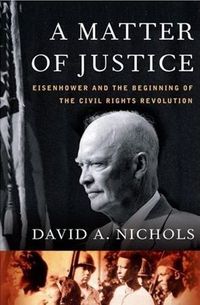
Fifty years after President Dwight D. Eisenhower ordered troops to Little Rock, Arkansas, to enforce a federal court order desegregating the city's Central High School, a leading authority on Eisenhower presents an original and engrossing narrative that places Ike and his civil rights policies in dramatically new light. Historians such as Stephen Ambrose and Arthur Schlesinger, Jr., have portrayed Eisenhower as aloof, if not outwardly hostile, to the plight of African-Americans in the 1950s. It is still widely assumed that he opposed the Supreme Court's landmark 1954 Brown v. Board of Education decision mandating the desegregation of public schools, that he deeply regretted appointing Earl Warren as the Court's chief justice because of his role in molding Brown, that he was a bystander in Congress's passage of the civil rights acts of 1957 and 1960, and that he so mishandled the Little Rock crisis that he was forced to dispatch troops to rescue a failed policy. In this sweeping narrative, David A. Nichols demonstrates that these assumptions are wrong. Drawing on archival documents neglected by biographers and scholars, including thousands of pages newly available from the Eisenhower Presidential Library, Nichols takes us inside the Oval Office to look over Ike's shoulder as he worked behind the scenes, prior to Brown, to desegregate the District of Columbia and complete the desegregation of the armed forces. We watch as Eisenhower, assisted by his close collaborator, Attorney General Herbert Brownell, Jr., sifted through candidates for federal judgeships and appointed five pro-civil rights justices to the Supreme Court and progressive judges to lower courts. We witness Eisenhower crafting civil rights legislation, deftly building a congressional coalition that passed the first civil rights act in eighty-two years, and maneuvering to avoid a showdown with Orval Faubus, the governor of Arkansas, over desegregation of Little Rock's Central High. Nichols demonstrates that Eisenhower, though he was a product of his time and its backward racial attitudes, was actually more progressive on civil rights in the 1950s than his predecessor, Harry Truman, and his successors, John F. Kennedy and Lyndon Johnson. Eisenhower was more a man of deeds than of words and preferred quiet action over grandstanding. His cautious public rhetoric -- especially his legalistic response to Brown -- gave a misleading impression that he was not committed to the cause of civil rights. In fact, Eisenhower's actions laid the legal and political groundwork for the more familiar breakthroughs in civil rights achieved in the 1960s. Fair, judicious, and exhaustively researched, A Matter of Justice is the definitive book on Eisenhower's civil rights policies that every presidential historian and future biographer of Ike will have to contend with.
 Media BuzzTavis Smiley - September 25, 2007
| 











 © 2003-2026