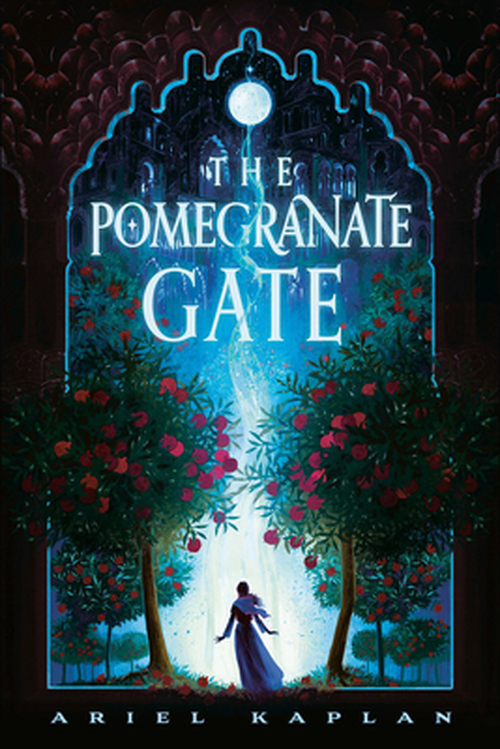
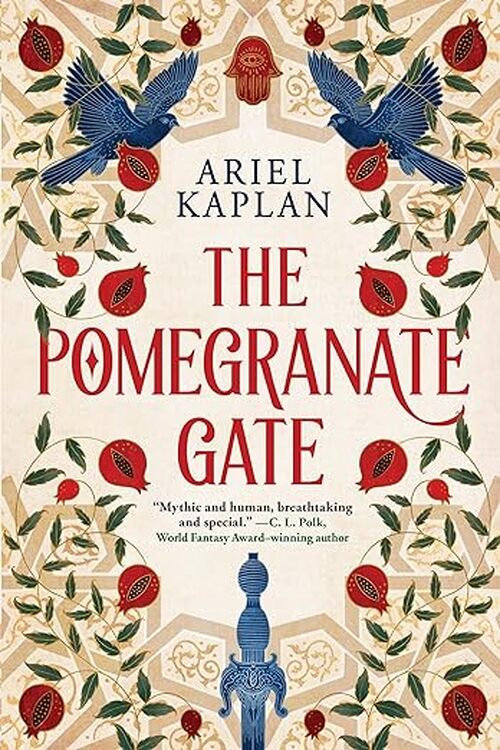
Toba Peres and Naftaly Cresques are young people with little in common, except that their families live in Rimon. Toba is taught as a scribe since she’s not physically strong. Naftaly is a tailor’s son. THE POMEGRANATE GATE is a fantasy, where their stories collide. The Queen of Sefarad orders the peoples of her newly conquered lands to convert or face inquisition. Claiming to be conversos won’t save anyone, as greedy eyes fall on the houses and trades of Jewish citizens.
Fleeing the city of Rimon, the two join a straggle of people and carts. One night, they discover a gate in a pomegranate grove. The legends warn never to trust a man met by full moonlight, but the young people run from wolves and discover a strange land much like their own, with men whose eyes are different and who carry magic. The Mirror Realm Cycle begins with this installment, which immediately splits the pair apart again. Toba gets to stay, against her wishes, and Naftaly gets returned to his land of exile, with his sense of honour binding him to the weak girl who may, or may not, pass through the gate again at the next full moon – and no sooner. He can visit the land in his dreams, but doesn’t see Toba.
The Jewish characters make for an interesting and sympathetic flavour, similar to Naomi Novik’s SPINNING SILVER. Naftaly’s family is trying to escape notice or pass themselves off as conversos, while in the mirror realm, Toba has entirely different problems and enemies. She meets scholars Barsilay and Asmel who live in a ruinous fort that used to be a centre of learning. Books she knows, so she offers to make herself useful in return for her keep. Because it’s a fantasy, we know it won’t be long before her latent magic starts to emerge.
This is a long fable and it took several days to read; meanwhile, the people were proceeding at the pace of a walk or an ox-cart, and Toba was sitting in one place. So the story is slow and driven by conversation and contrast. I’m annoyed that a major character is referred to as "the old woman" throughout; even if she didn’t want to give her name, many cultures would see younger people call her ‘Auntie’ for respect. Sefarad is a Hebrew term for the Spanish and Portuguese peninsula, but nothing rang particularly Spanish to me, except that there’s also an Arab quarter in Rimon and pirates on the seas. The setting is an alternate world somewhat like our own, with the same tragedies and prejudices as in our past. Tensions arise from lust for power and the sources of magic, building to violence, rage, and ruin.
THE POMEGRANATE GATE could be read by older YA readers, but I feel it doesn’t move fast enough (or have enough romance) to keep their attention. Ariel Kaplan has previously written modern YA fiction such as WE REGRET TO INFORM YOU. This is her first series, with plenty of threads left untied to sustain more books. I’ll be interested to see how the story continues.
No excerpt available.










 © 2003-2026