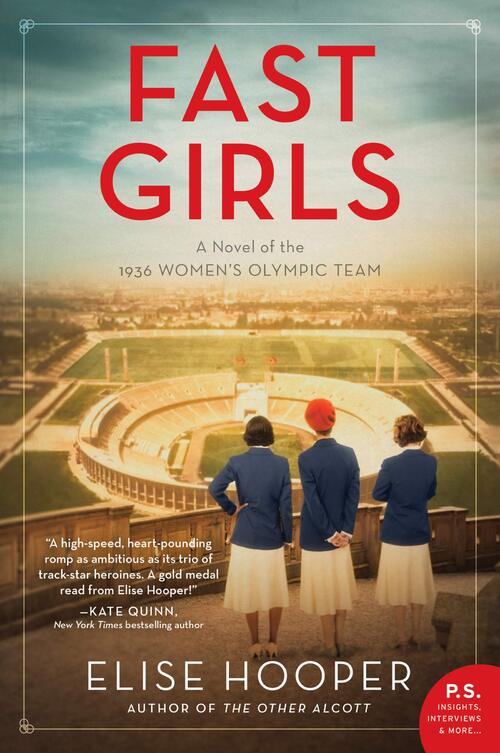
While this epic adventure starts almost a hundred years ago, FAST GIRLS: A Novel of the 1936 Women's Olympic Team continues follows the leadup to WW2. I’ve read so many social history novels about girls starting out poor and succeeding despite the odds, but these were real young women, living real lives. Some of them inspired a generation of track and field athletes – and women in general. This is The Right Stuff for women’s athletics.
Chicagoan Betty Robinson first makes her mark in the 1928 Amsterdam Olympics, winning two medals, despite her father’s disapproval. This is at the very start of women being allowed to compete. The newspapers are full of scandalized comments about the harm running will do to young women - physically, mentally, emotionally, and perhaps even morally.
Coming from a town near Boston, tall Louise Stokes is a misfit and tomboy. She isn’t pretty or dainty. Running is the only way for her to achieve anything in life. She thinks, but she hides a secret.
Hardworking parents in Missouri raise Helen Stephens. Her mom loses her housekeeper job and Helen knows she’ll have to drop out of high school and lose her place at Williams Wood College. Black girls like Helen and her friend Tidye don’t have chances like the other runners – can’t share the same hotel rooms, can’t dine with the team. Even being selected is an achievement surpassing her family’s dreams. But winning race after race at record speeds may not be enough to get Helen selected in the 1932 California Olympic finals, so are her hopes of the Nazi-organized 1936 Olympics in Berlin also destined to fail?
While I admired each of these ladies, and the other teammates, maybe the toughest fighter of all is Betty. She was severely injured in a crash of a friend’s light plane and could have given up on her sport. Instead, she learned to walk again and came through with the intention of making a relay team. None of the ladies had it easy. Those coming from money, found the family wealth melt away during the stock market crash and depression. The Olympic Council had little funding for any athletes to travel, and the fast girls had to pay their own way in many cases. Even their coach and chaperone wasn’t paid. The girls could not earn from their sport or lose their amateur status; the assumption was that they would marry and lose interest, so I cheered when married women with babies returned to the track. Delightfully, whole communities came forward with sponsorship. One such case was a Polish American, Stella Walsh, whose costs would be sponsored by Poland, and even a college course, provided she raced for Poland. What would you have done? And if you were an Olympic hopeful, asked to boycott the German Olympics on moral grounds? Importantly, of course, the people of 1936 had no knowledge of how bad matters inside Nazi-controlled countries would become. We are shown a moment or two which sent chills down my spine, and I don’t know if they really occurred, but we’re in no doubt as to the author’s sensibilities.
Elise Hooper has created a remarkable achievement by researching the lives, media and times of the FAST GIRLS and adding historical notes at the end of her work. My sport was showjumping, and by then women were not just accepted but heroes. The ground had been broken by women ahead of me, fast girls over fences, in a male dominated sport, just as all sports were. Whether you run or enjoy other sports, the Olympics can’t fail to grab your attention. Reading FAST GIRLS will show you the history of the Games as well as these athletes, and the speed of wo’en's progress.
Acclaimed author Elise Hooper explores the gripping, real life history of female athletes, members of the first integrated women’s Olympic team, and their journeys to the 1936 summer games in Berlin, Nazi Germany.
This inspiring story is based on the real lives of three little-known trailblazing women Olympians. Perfect for readers who love untold stories of amazing women, such as The Only Woman in the Room, Hidden Figures, and The Lost Girls of Paris.
In the 1928 Olympics, Chicago’s Betty Robinson competes as a member of the first-ever women’s delegation in track and field. Destined for further glory, she returns home feted as America’s Golden Girl until a nearly-fatal airplane crash threatens to end everything.
Outside of Boston, Louise Stokes, one of the few black girls in her town, sees competing as an opportunity to overcome the limitations placed on her. Eager to prove that she has what it takes to be a champion, she risks everything to join the Olympic team.
From Missouri, Helen Stephens, awkward, tomboyish, and poor, is considered an outcast by her schoolmates, but she dreams of escaping the hardships of her farm life through athletic success. Her aspirations appear impossible until a chance encounter changes her life.
These three athletes will join with others to defy society’s expectations of what women can achieve. As tensions bring the United States and Europe closer and closer to the brink of war, Betty, Louise, and Helen must fight for the chance to compete as the fastest women in the world amidst the pomp and pageantry of the Nazi-sponsored 1936 Olympics in Berlin.










 © 2003-2026