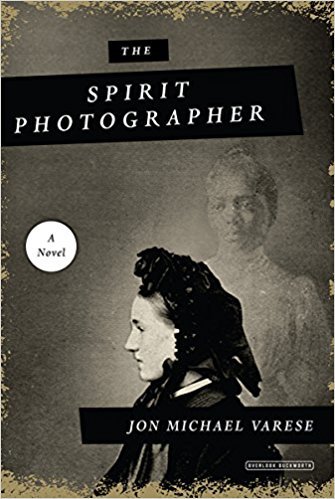
The Civil War may be over, but it has left a lot of women mourning husbands and sons. This has seen an increase in spiritualism. And in Boston, there is a man, Edward Moody that is said to be able to take your picture and your dearly departed will appear as a ghost in the picture. Despite many people proclaiming he's a fake, so far no one has been able to expose him as a fraud. However, when he's taking the photographs that should show the ghost of the dead son to an abolitionist senator instead of boy there is a beautiful woman in the photograph, a woman Edward recognizes...
I was instantly intrigued by the idea of a photographer that earns a living out of grieving widows and mourning mothers by taking photographs of them that will show a ghostly image of a dearly departed. And on his latest job, he discovers that the woman he fell in love with and who disappeared years before shows up in the photograph when there should be a little boy. It's an interesting mystery that will take Edward from Boston to Louisiana as he is both haunted and hunting. There are people out there that will not stop until the photograph is destroyed, not to mention those that want him to stand trial for deceiving people. Edward himself wants to find out the truth about what happened to the woman he fell in love with, the woman that he has never gotten over.
THE SPIRIT PHOTOGRAPHER is an engrossing novel set five years after the Civil War ended. Spiritualism is on the rise and there are a lot of frauds out to make money from people's grief. I like how the story is both told from the senators and his wife's POV as well as Edward Moody's. In some ways they are connected and as the story progresses, we learn more about what happened all those years ago when a young beautiful woman vanished. It's a book that is beautifully written with a fascinating story. Jon Michael Varese has truly captured the period and I'm eager to read more from him in the future.
For fans of Cold Mountain and The
Alienist, the stunning debut novel of historical
suspense about a charismatic conman haunted—perhaps
literally—by a ghost from his past
Boston,
1870. Photographer Edward Moody runs a booming business
capturing the images of the spirits of the departed in his
portraits. He lures grieving widows and mourning mothers
into his studio with promises of catching the ghosts of
their deceased loved ones with his camera. Despite the
whispers around town that Moody is a fraud of the basest
kind, no one has been able to expose him, and word of his
gift has spread, earning him money, fame, and a growing
list
of illustrious clients.
One day, while developing
the
negative from a sitting to capture the spirit of the young
son of an abolitionist senator, Moody is shocked to see a
different spectral figure develop before his eyes. Instead
of the staged image of the boy he was expecting, the camera
has seemingly captured the spirit of a beautiful young
woman. Is it possible that the spirit photographer caught a
real ghost? When Moody recognizes the woman in the
photograph as the daughter of an escaped slave he knew long
ago, he is compelled to travel from Boston to the Louisiana
bayous to resolve their unfinished business—and perhaps
save
his soul. But more than one person is out to stop him . .
.
With dramatic twists and redolent of the mood of
the Southern Gothic, The Spirit Photographer
conjures the Reconstruction era South, replete with
fugitive
hunters, voodoo healers, and other dangers lurking in the
swamp. Jon Michael Varese’s deftly plotted first novel is
an
intense tale of death and betrayal that will thrill readers
as they unravel the dreadful mystery behind the spirit in
the photograph and what ultimately became of her.
EXCERPT
ON THE DAY before Senator Garrett’s departure for Boston, news of
impending storms had disrupted the city, and so by the time his
brougham began climbing up Pinckney Street toward Louisburg Square,
nearly all of the windows on Beacon Hill had already been locked
and shuttered. Up ahead, on the corner of Pinckney and West Cedar,
Garrett spied two lone figures, their hands firm on the brims of
their hats. It was old Dovehouse conversing with the new
choirmaster from King’s Chapel.
The carriage approached, its wheels rattling in the street.
“Back again, old boy?”
“I am, sir,” Garrett replied.
“Good to have you. Congratulations on your victories. I never
doubted them for a second.”
The senator returned a nod. Dovehouse never doubted anything—a
characteristic that had been amusing Garrett for close to forty
years. The “victories” to which old Dovehouse referred were the
many Republican triumphs from the previous congressional session:
the ratification of the Fifteenth Amendment, giving freedmen the
right to vote; the passage of the first Enforcement Act, empowering
the Federal Government to prosecute the Klan directly; and the
election of Hiram Revels, a black Mississippi minister, to
Jefferson Davis’s old seat in the Senate chamber—a change
unimaginable twenty years earlier, when Senator James B. Garrett,
at the age of thirty-nine, had begun his career as a statesman.
“I suppose we can move on with things now!” Dovehouse called out as
the senator’s carriage continued up the street.
Garrett offered no reply. With the readmission of Georgia—the last
of the outcast Confederate states—back into the Union, there were
those, like Dovehouse, who had emphatically declared the country
reunited. But Garrett had no intention of “moving on”—at least not
until he had secured fundamental rights for all the country’s
citizens.
When the senator at last arrived at his house, it too was dark and
motionless, except for the swirling clusters of maple leaves in
front of it. The house glared at him as if it were displeased with
his lateness, and its unblinking frown gave him no comfort. When
the front door opened, and Garrett descended from the carriage, a
sudden gust of wind scattered the leaves from his path. In the
doorway stood a heavyset woman wearing a gingham dress.
“Welcome home, sir,” Jenny said.
“Dear Jenny . . . is something the matter?”
“It’s Mrs. Garrett—she’s received a letter. She’s waiting for you
in the drawing room.”
His Jenny. She had been with him for nearly twenty years now. He
stepped inside, handing her his hat and his gloves. His face, he
knew, betrayed him.
“Sir?” Jenny said.
“Thank you, Jenny,” Garrett said.
The groans of the hinges welcomed Senator Garrett as he opened the
great doors of the drawing room. The room’s curtains were drawn,
blocking out most of the day’s remaining light, and outside the
wind howled unmercifully.
“Elizabeth?”
In the dimness, his wife’s profile emerged.
“James—” she said. “We’ve heard . . . we’ve heard from . . .”
Elizabeth’s chin fell, and Garrett moved toward her. She released
what was in her hands with a surprising lack of resistance. Garrett
approached the curtains and held the letter near the split of
light.
17 July 1870
Dear Mrs. Garrett,
I write to inform you of the miraculous news—we have received word
from your son, William Jeffrey. He has made contact through a
dream, and he is bathed in flowers and sunlight.
I realize that this message arrives sooner than I had predicted,
but the movements of those in the spirit world can be rather
sudden, and as such we must move with great speed. Please come to
the gallery tomorrow at one o’clock in the afternoon, so that we
may execute your photograph immediately.
Yours sincerely,
Edward Moody, Photographer
258 Washington Street, Boston
Garrett read the “news” with a mixture of uncertainty and disdain.
Two weeks earlier, Elizabeth had written him in Washington to tell
him that she had made a visit to Mr. Moody—the so-called “spirit
photographer” who had achieved notoriety in recent years. “It
appears that Mr. Moody has a gift,” she had told her husband, and
when he read those words he was surprised, for his wife had always
been the more skeptical of the two of them. A man who could
photograph spirits? It was not something one would have expected
Elizabeth to believe in. He had thought that her initial letter
might have described a whimsy; but when a second letter arrived,
citing Colfax’s highly publicized visit to Moody, he recognized
that his wife had become attached to this idea.
Now she was looking over at him imploringly, which was another
strange thing, because his wife usually demanded rather than
implored. But he understood, for just the sight of his son’s name
scribbled on a folded piece of paper was enough to unbury what so
much rehearsed forgetting had kept secreted away for years.
“Elizabeth—” Garrett said.
And when he said her name she knew, because she was able to read
him better than he could ever read himself.
“James,” she said, “I know your thoughts on this matter. I too have
my reservations. But if he is a man of extraordinary power, as some
claim, and if he could provide us with—”
She paused, no longer his supplicant, but his commander.
“Think of what it could mean.”
He studied the letter again, read it from beginning to end.
“James, we must waste no time.”
The senator inhaled deeply.
“Very well then,” Garrett said. “We’ll go tomorrow afternoon, as he
says.”
That night, as Elizabeth breathed quietly beside him, Garrett
clenched the bed sheets and stared at the moving shapes above his
head. The wind had grown even more impatient, causing a violent
parade of shadows on the ceiling.













 © 2003-2026