Reading is supposed to be an escape. Why would we want to read the same kind of stories of terrible violence that are in the world today? But what of the women who can't get away from the horrors?
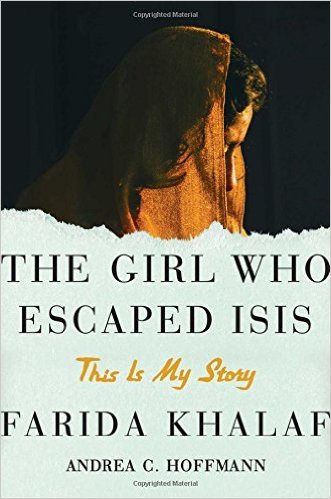
THE GIRL WHO BEAT ISIS lets us inside the world of some women who live in hopelessness and are desperate for escape.
Farida Khalaf was taught to fire a rifle by her father at age fifteen. They lived in northern Iraq, raising sheep and vegetables. But her family were Yazidis, speaking Kurdish. While the Muslim Arab people in the nearby villages seemed friendly and traded, they were sure to keep apart and the minority Yazidis were not allowed to marry Muslims.
Farida learned that in the past there had been bad relations between the two populations. She wore relatively modern clothes and was not obliged to cover her head. Compulsory education was introduced in 1970 and aged eighteen, Farida was the best educated in her family, loving math and physics.
Life changed with the rise in neighboring Syria of a terrorist group, DAIS or Daesh, better known in Europe and America as IS. Repelling government forces, this group started persecuting other religions and brutally requiring everyone to obey them. Farida's father was a soldier, and had to guard the border. He was worried that the refugees would include agents of IS. These people, he told her, were funded by the oil states, Saudi Arabia and Qatar, and were supplied with arms by Turkey.
But the spreading strife was just on television... until Farida and her girlfriends Evin and Nura discovered that bombs were exploding in nearby cities. How could they stay safe from suicide bombers and an invading well-armed force?
IS, joined by released criminals, at first wanted cities, oilfields and dams, but when they conquered those, every village would be at risk.
The story is nail-bitingly tense and reconstructs the civil war and the flight of thousands of Kurds to the top of a mountain. Farida's family was not among them, and suffered terribly. Robbery, captivity, slavery and beatings awaited her, so this is not a tale for the tender but remember that Farida and her friends were the tender ones facing death.
The evil men bought little girls before young women, so Farida continually tried to escape while she could, and I have to admire her bravery and persistence. Evin, too, deserves high praise, faithfully staying with Farida who had occasional epileptic fits from the stress. The girls formed an escape committee and never stopped working to get free or make contact with the outside world. I have to hope I could be so brave.
In the aftermath of the foul treatment the girls endured, Farida tells us that the ingrained attitudes of her own people were awful, making her feel ashamed when she had done nothing wrong.
This lesson is one we could all take to heart. The co-writer Andrea C. Hoffman leaves us in no doubt that the inspirational source for THE GIRL WHO BEAT ISIS will go a long way. This book is available through common book sales sites and will give readers a good understanding of the horrible life endured by ordinary people living under ISIS rule.
No excerpt available.










 © 2003-2026