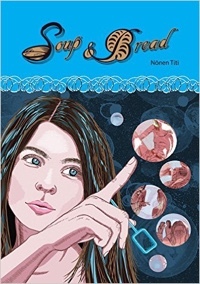
SOUP AND BREAD, a young adult contemporary adventure, deals with family
relationships, school likes and dislikes, and the
awkwardness of growing up. Vonnie finds that her life has
many pitfalls.
SOUP AND BREAD seems like a simple and philosophical diet.
However, we all know that most young people want cake, ice-
cream, sweet drinks, tasty main courses, and maybe not too many
vegetables. Some of them even go on faddy stretches of not
eating other foods. In this tale Vonnie and Laura's mom
lectures them about nutritious food, but between their fads
and her husband's preference for meat and tatties, she has
her work cut out to cook a meal.
Despite the insistence of the teachers that this is a zero
tolerance school, we still find that dreadfully, Isabel, a
pal of Vonnie's, has had her violin's neck broken and has
herself been threatened. No wonder the poor girl can't keep
food down when she thinks of class and music practice.
Bullying is extremely harmful to growing people and
reflects the ignorance and envy of the bullies.
When Vonnie and Laura see that their mom has cleaned out
the cupboards and fridge, and is on a soup and multigrain
bread regime, they are dismayed. Their lunch boxes are
equally simple and breakfast is porridge. Vonnie complains
to her friend Rinah, whose Asian mother prepares healthy
meals too. Frank, the strongest guy in class who despises
bullies, has to explain to the girls about his diabetes. He
knows a lot about carbs and proteins, and the girls start
to learn. But that doesn't solve the tensions - at home or
at school. They'll just have to tough it out.
I found it unusual to read a story where everyone is
constantly eating something, or not eating and complaining
about the food. Different outcomes of eating different ways
are shown, including anorexia, and a chart of Blood Sugar
Levels for Diabetics is at the end after the story's
dramatic conclusion. SOUP AND BREAD is a really unusual
adventure dealing with more than one major issue for those
concerned, and Nonen Titi has seasoned her well-written
story with a great deal of information to help young adults
understand their lives. While the author lives in New
Zealand, I believe this tale could occur in many places
around the world, so perhaps it's true to say that we have
too many choices of what to eat, and too many adults
unprepared to listen to unhappy young students. The real
lesson of SOUP AND BREAD is that we should be prepared to
listen and to make changes for the better. Any family with
a diabetic adult or child will be especially interested in
reading this adventure.
For Vonnie, dinnertime means Mum complaining that she's
picky, and school
means PE (ugh!) and bullies - but she's learned to ignore
them.
But now Mum's threatening to make soup and bread for
every meal - forever -
and Frank, the new kid, is picking fights, and Vonnie
can't ignore them.
But she can't do anything... right? She's just a kid.
EXCERPT
SPOILT
“Vonnie is spoilt,” Mum says when Rinah’s mother brings
me home after I stayed for dinner on Sunday night.
Only, I didn’t eat any of her dinner.
“She didn’t even give it one little try,” Mrs Timisela
says about the yellow rice with red and green vegetables
that I’ve never had before.
That’s when Mum tells her I’m spoilt. Mum always says
that about me. And the worst thing is that Mum’s the one
who spoilt me. That’s what Mum says, anyhow.
Laura’s spoilt too, of course. Mum did that as well. And
to top it all off, Dad is spoilt too, but Mum didn’t do
that; he came that way from Grandma’s home.
Mum can’t say how it started. “When Vonnie was a toddler,
she used to eat everything – unlike Laura, who only
wanted those mushy foods from a jar. Vonnie would eat all
her vegetables,” she tells Rinah’s mother, who’s leaning
against the front door but says she doesn’t want to come
in because she has to “get the kids to bed”.
I sit down on the bench in the hall to take off my shoes.
Mum was in her “really healthy” phase when I was one and
Laura was four. Everything had to be wholemeal and raw
vegetables. That’s what Dad told us.
“But it made no difference; now she’s just as spoilt as
Laura,” Mum says.
Dad comes out of the kitchen and pats my head before
joining them. “It isn’t that bad,” he says. “They’re good
girls. We never have to ask them twice to help with
something, they share and they even put some of their
pocket money into the Salvation Army collection
yesterday.”
But Mum insists we’re spoilt when it comes to food. Dad
used to be just like us. He used to eat nothing but
mince, tatties and canned peas when they were first
married, but she doesn’t say that to Rinah’s mum. And Dad
has “improved” since then. Now he even eats nasi goreng
with sambal, like Rinah’s parents.
Rinah’s dad is from Indonesia. Her mum isn’t, but she
cooks the food. Rinah looks like her dad on the outside,
but she has no accent and she only likes Western food.
But her mum is really strict and Rinah always has to
empty her plate or she won’t get dessert and no treats
the next day, and that’s a shame because Rinah’s mum
makes yummy desserts. I saw them sitting ready in their
fridge: tall glasses with blackcurrant syrup at the
bottom, then yellow custard and white yogurt, and on top
a slice of orange and a wafer for decoration. It looked
SO yummy...but I didn’t get it either, because I didn’t
eat the rice.
Mum thinks desserts give us extra proteins and she read
somewhere that most adults who are overweight were forced
to finish their dinner when they were kids, but Mrs
Timisela doesn’t believe in substituting meals. She says
she won’t spoil her kids with biscuits and muesli bars.
She says the only way to appreciate food is to go
without.
Then she says, “Goodbye Yvonne,” and leaves.
“I’m tired of cooking,” Mum says on Monday evening,
looking over the edge of her steamed-up glasses when
putting our plates on the kitchen table. “I’m tired of
making three different meals every night because Vonnie
only eats macaroni cheese and Laura wants nothing but
baked beans.”
And since Dad doesn’t like pasta or beans, she has to
make him rice or tatties every day with plenty of meat.
Dad doesn’t believe a meal is complete without meat in
it, but Laura and me don’t like meat – except sausages
and burgers. Mum doesn’t care about meat either, but she
thinks a meal should always have vegetables for their
vitamins and minerals, because she worries about our
health.
So Dad gets his vitamins from the fruit-and-yoghurt drink
Mum mixes in the blender for him and from eating salads
at work. Laura and me don’t like the sour drinks or
salad, so Mum squeezes oranges for us in the morning.
Laura sometimes ‘forgets’ to drink hers when she’s in a
hurry to catch the bus. I always drink mine, but only
after Mum has put it through the sieve so there are no
pulp thingies in it. And today she’s made a big platter
of strawberries with cream for all of us, because it’s
“the only food nobody pulls up their noses at”.
“But all the goodness is lost with the amount of sugar
you pour on top of it,” she says to me.
Mum has complained about how much sugar I eat ever since
our school had a Health Awareness Week last month. The
little kids, like Rinah’s sister Sitha, made food
pictures and brought their toothbrushes to school, but we
had to do a math project. First we had to record
everything we ate and drank for the whole week and how
much exercise we did, and calculate how many calories
we’d eaten and how many we had exercised away. Then we
had to compare and everybody had eaten more than they
exercised, so the school complained to the parents about
kids eating too many sugars and processed foods, which is
why some children can’t sit still or concentrate and
others are “controversial”.
So now Mum feels guilty again and that’s why she’s
complaining about how much sugar I put on my
strawberries.
“And you’re all drinking way too many soft drinks; I’m
tired of getting them.”
She always complains about that too, but she still buys a
new bottle in the supermarket every day.
“Lunches are a disaster,” Mum says on Tuesday morning
when the toast burns because she’s trying to fix
lunchboxes at the same time. “No variety. I’m sick of the
sight of them.”
She closes Laura’s box with a bang.
Laura always has ham on slices of white bread – “dough
balls”, Mum calls them. I also have dough balls, but mine
have peanut butter, and I like white rolls with nothing
on them.
And today breakfast is a disaster too, because there’s no
more bread for new toast, so Mum says to get some cereal
instead, but then there isn’t enough milk for all of us
and Dad’s coffee, so Mum says to just grab a muesli bar
and a handful of biscuits and she’ll buy more when she
goes shopping.
“You know, Mum,” Laura says, splitting the roll of
biscuits in half and cutting each of us some cheese from
the block, “if you’d agree to get a microwave you
wouldn’t have anymore dishes and no more need to complain
about cooking. We’d each make our own.”
“Then we’d never have a family meal anymore and all you’d
eat would be processed junk.”
“Well, it’s either nutritious meals together or no dishes
and no stress. You can’t have it both ways, Mum.”
Laura uses her napkin to wipe her glasses clean and then
wraps her cheese in it. “I’ll eat it on the way,” she
says and shouts goodbye to Dad, who’s standing watching
the news in the living room.
I quickly stuff the cheese in my mouth and the biscuits
into my bag and run upstairs to brush my teeth.
Like always, Mum hands me my lunchbox when I’m putting my
shoes on in the hall and she waits at the door until I
reach the path that leads to Rinah’s house so we can
wave. From her house, me and Rinah walk together,
following Main Street all the way to the round-about,
where we turn into High Road and through the school gate
onto the path that leads to the playground.
On the way I tell Rinah about the breakfast disaster and
she tells me she tripped on the stairs when sneaking down
for some milk in the middle of the night because she was
hungry and couldn’t sleep.
We share all our mother troubles every day, just like we
share my muesli bar and peanut butter dough balls and her
banana for lunch. When it rains, we eat in class, but
today it’s dry, so we take our lunches out of their boxes
the moment the bell goes and run to the benches in front
of the teachers’ room to share our food there.
Mum makes me four slices of bread now that I’m in Year
Six because she thinks I need more energy, but she
doesn’t know I asked for them so Rinah won’t be hungry at
school. Rinah doesn’t get peanut butter anymore ever
since the school told all the parents that the allergic
boy in Year One will die if he touches peanut butter. But
Mum says she won’t let me go hungry for a child I never
even see, so she just warned me to wash my hands after
lunch and to pack the leftovers back into the box so
nothing can happen. But we never have leftover peanut
butter, only Rinah’s sourdough with cheese and that’s not
dangerous in the bin.
At the end of recess we go to the canteen and buy potato
chips with our snack money and, just in case Rinah
doesn’t like her dinner, we go to my house after school
to have cookies and ice cream while we watch Animal
Planet.
“I’m fed up,” Mum says at dinnertime and pulls away my
plate, where my macaroni people on the edge have just
been covered with a cheese avalanche. “You play with your
food when it’s nice and warm and then you won’t eat it
when it’s gone cold. I’ve had it, Yvonne, I’m not making
you any more macaroni. You can have milk and cereal for
all your meals from now on.”
I shrug to say I don’t care. She tried to make us eat
cereal every day once before when she had “a phase”, but
then she worried about the vitamins and started making
extra fruit salads until it was easier to just cook
macaroni, beans and tatties again.
“You never eat, yet you’re full of energy, which means
you must be burning sugar,” she complains.
“I didn’t have any sugar.”
“Well, I think we should cut down on after-school snacks.
Especially now you’ve given up on Saturday gym as well.”
“I didn’t give up, but it’s no fun without Rinah.”
“So why did Rinah give up? I thought she was really good
at gym.”
“She just didn’t want to go anymore,” I tell her.
“Maybe you should try and find another sport you both
like.”
But there isn’t any sport I can think of that I’d want to
try.
Dad puts down his fork and pushes his empty plate away.
“That was nice,” he says. “But could we have something
other than tatties tomorrow? If I eat any more of those
I’m going to turn into a couch potato.”
He pulls a face, but Mum doesn’t think it’s funny. “I
asked you this morning what you wanted and you said you
didn’t know!”
“I can’t think about dinner at breakfast time,” Dad says.
“Neither can I, but I have to do the shopping. I’m not
doing it anymore. And I won’t do any more dishes.”
Mum slams the plates back down onto the table and drops
the tea towel down beside it. Then she leaves to sit in
the living room with the TV on, so Dad has to clear the
table and do the dishes, and he makes coffee at the same
time. “She’s pouting,” he says to us. “She needs a rest.
She hates cooking.”
“At least she doesn’t go into that ‘poor kids are
starving’ routine,” Laura says, drying off the dishes so
I can put them in the cupboard. “I can cope with
pouting.”
“And with complaining,” I agree and all three of us have
a secret giggle about that.
Mum always pouts and complains about food. For everything
else she’s a really fun mum to have, but when it comes to
food she’s complained for as long as I remember. It’s
like a theme song.







 © 2003-2026