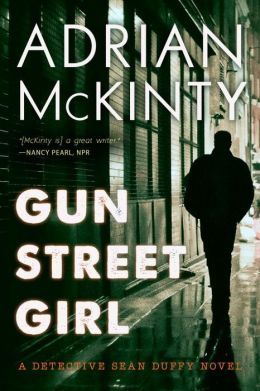
Fourth in the series about Detective Sean Duffy, this book was my introduction to this author. Crime in the North of Ireland is complicated by having two rival jurisdictions meeting at a border of this small area, and compounding the difficulties for police, this tale GUN STREET GIRL is set during the Troubles when two tribes met with a scowl rather than a smile.
In 1985 the RUC has the highest mortality rate of any police force in the Western world. Inspector Duffy joins an arrest squad waiting to seize the crew of a boat carrying guns to the north Antrim coast. Shortly afterwards he's called to an expensive illegal brothel where an American film star assaulted a girl who refused to sample his cocaine. I was seeing already that the situations were complex, international and farcical. The real meat of this tale is however a personal double murder situation in a wealthy bookie's home.
In which other crime settings would everyone from colleagues to neighbours be catalogued according to where they worshipped? A dour Presbyterian sergeant, a cocky Protestant gangster, a left-foot Catholic inspector. All as matter-of-course, easily discerned and seldom discussed. The bulk of the police are not Catholics at this time, so one community automatically distrusts them. All RUC officers are armed with revolvers, which is not the case in the rest of Britain and Ireland. They police riots and daily check under their cars for bombs. Maybe the tensions go some way to explaining why Catholic Duffy makes free with confiscated cocaine.
Back to the double murder case - when a suicide is reported. Duffy leaves an embarrassingly stilted social evening with the one female who will speak to him, a reporter for the Belfast Telegraph. Did the killer throw himself off a cliff, or is it all some obscure setup? I got confused when for no apparent reason the scene suddenly shifted to Oxford, where a well-connected student had overdosed herself with heroin. This seemed entirely unrelated, and Thames Valley Police were handling it but allowed the NI inspector to ask questions. A connection was suggested after a few chapters, but a few bridging lines earlier to explain the trip would not have hurt.
Atmospheric and laconic, the tale strikes me as a Northern Irish version of the Rebus series; a music-loving, isolated, irreverent inspector who doesn't follow all the rules and has uneasy contacts with crooks and spooks. As the complications escalate with politics in GUN STREET GIRL, author Adrian McKinty enjoys keeping us guessing and recreating difficult times with the benefit, of course, of hindsight.
No excerpt available.









 © 2003-2026