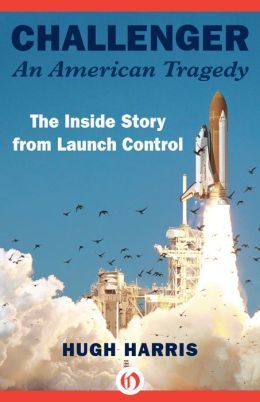
On January 28th, 1986, the Challenger space shuttle failed in its mission to bring astronauts into space safely. The author Hugh Harris, who was present, reconstructs what went wrong, and succeeds in making this a very human story.
CHALLENGER - AN AMERICAN TRAGEDY is a short book with several excellent photos, including the icicles dangling from the rocket on the morning of her launch. Troughs of water under the launch pad should absorb the sound waves, to stop them reflecting onto the ship; these troughs with added antifreeze had all frozen and had to be broken loose, emptied and refilled with stronger antifreeze. These scenes made me think that nobody sane would start a risky journey in a car on a day like that one.
Looking from the perspective of NASA's news reporter Hugh Harris, all was going well. Every word spoken by the brave astronauts, which included a civilian schoolteacher, was relayed to flight control. Launch seemed to go well, but a minute and thirteen seconds later Challenger exploded. The shock among watchers was extreme, and after some seconds professionalism took over, as Harris puts it. All notes taken were impounded in case they might shed light on the cause of the disaster.
President Reagan was told and immediately postponed his State of the Union Address. Vice President George Bush was aboard Air Force One when it touched down at the launch base at 5:30 PM. Former astronaut John Glenn was one of the senators aboard Air Force One. Their concern was to meet the families.
An investigative committee, chosen by Reagan and independent of NASA, was assembled. It is doubtful that such powerful names have ever been employed on one project; Richard Feynman, Neil Armstrong, Sally Ride, Chuck Yeager, are the best known to the public. Reporter Jay Barbree got straight to work asking his sources for information and quickly found that analysis of video tapes showed the failure point. Gaining confirmation, he broke the news on TV. Between the efforts of the committee and the press, the engineering problem, parts that could not handle the extreme cold, became so well known that it is now taught in many school over the world. Sound advice was ignored. The rest of the book looks at the recovery of the wreck, engineering processes and finally, the next staffed space launch, three years later.
Harris reminds us of the many benefits of the space programme, from satellites for weather forecasting and telecommunications, to biomonitoring and new materials. The International Space Station is one of humankind's greatest achievements. This book will interest those starting to study engineering or aircraft design, and media studies, for it is neither so simply written as to be for the general reader nor so densely technical as to be only for the scientist. Anyone wishing to analyse that brief period in history will also find it fascinating. I would point out that the whole world was watching that day. This book may be called CHALLENGER - AN AMERICAN TRAGEDY but it was actually a global tragedy, one which has not been forgotten.
No excerpt available.













 © 2003-2026