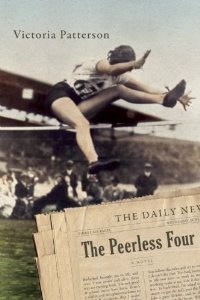
THE PEERLESS FOUR is a fictional account of four young ladies who participated as representatives from Canada in the 1928 Olympics in Amsterdam. It was only a trial basis for women to be participants in track and field events. Prior to the 1928 Olympics, women were only allowed to participate in "lady-like" events. Florence Smith loved basketball, but could not play at school because she was a girl. She was just as good as her brothers, and could run like the wind. Bonnie Brody just loved to run, and she loved her coach, sometimes a little too much. Ginger Hadley was the "Dream Girl" on the team. Her beauty rivaled her running talents, and the media loved her. She cared only about running and none of the glitz and glamour. Muriel Ziegler, whom they nicknamed Farmer, was the field event superstar, mastering the javelin and shot put with little effort. Being the oldest at twenty-two, she was their captain.
Jack Grapes is the promoter who put this team together, along with his secretary, and the girls' chaperone, Mel (Marybelle Eloise Lee) Ross. Mel and her husband were somewhat estranged at the time, and she longed to have some purpose in her life. The group travels eight days by steam ship across the Atlantic to reach Amsterdam. They travel with other Olympians and the ship is outfitted for them to practice and work out during their journey. The story takes us through the events of the Olympics, back to Canada and the aftermath of having participated. Will the girls be successful at the Olympics? Will there courage and determination change the course of history? Did their glory end in Amsterdam?
THE PEERLESS FOUR is not just a story about four girls who went to the 1928 Olympics. It's a story about winning and losing, not just in sports, but in life as well. A sport has rules and regulations and is very ordered and easy to understand. Life is not so easily understood. There is no right or wrong answer to our questions sometimes; we just make choices. Most of these girls escape life through their running. They discover that it's more about the struggle than the triumph. In life, we lose sometimes, but we have to go on living. This story deals with social attitudes and change. All the characters are strong and realistic. Each character has their personal story told, including Jack and Mel, who narrates the story in first person. Victoria Patterson masterfully incorporates a lot of philosophizing about life into the narration. It's a very different type of story, but one that I thoroughly enjoyed. I highly recommend it!
The Peerless Four and Hugh Williams
Before the 1928 Olympics
Florence Smith
Basketball brought me to life, and once I was awake and
alive, there was no turning back. I'm not good at school,
never have been. There's a clarity and straightforwardness
to basketball, to sports, that I understand. There are
rules. You follow the rules and try to win. Life isn't like
that. Too bad, because in life you have to work to make
anything make sense. Life is deceptive. In basketball, I'm
asked to be smart: to get the ball, pass the ball, fake a
pass, dribble, and to shoot the ball through the hoop. When
I run, I'm asked to run as fast as I can, beat the others.
Cross the finish line first. I have a job to do, and I
either get it done or don't. There's nothing vague about it.
It's very clear. Life is tough and disappointing and I can't
control anything, so to me the best answer is sports.
There's no right or wrong answer like with arithmetic. I'm
not asked to come up with something like you have to in
English. I don't have to decipher a story or a poem. I'm
connected to others, and we're connected through time, when
it was clear and straightforward then, like it is now.
There's no trick answer, nothing that you have to interpret
or guess. I don't understand Shakespeare or algebra or why a
poem makes people cry, but give me the ball, and I'll
dribble and pass, and I'll take the elbow to the face, the
lumps and the bruises, gladly, to know that I'm doing
something truly fine, something that's as good as
Shakespeare, if you ask me, as good as any poem, even
better, if you ask me. It's action. It has the kind of power
and force of the known, and I gave myself over as soon as I
discovered basketball. I knew that I'd found an answer to my
life. I was alive.
At first, my dad wouldn't let me play basketball. I was ten
and we would go to my brother's games at the high school.
I'm the only girl of five children, and being from a family
of boys, I did everything that they did, which confused my
dad, since it wasn't ladylike. That's how I got into
running, because of my three older brothers. I ran to keep
away from them.
"I want to do that," I told my dad at the basketball game,
and he shook his head and said, "That's not for girls." It's
very simple, really. Boys play sports and girls watch the
boys play sports. My dad believes that girls should stay
home and work and bring the money home until they get
married. Girls shouldn't go to college—fine by me!
Only the boys should. But I wanted to be on the basketball
court, and I didn't care what my dad said.
I'd watch my brother with his squeaking shoes crossing the
court, dribbling and passing, making his shots, and he gave
meaning to my life, gave me a purpose. I cheered for him
with such yearning and enthusiasm that my dad would put his
hands on my shoulders, beg me to sit back down. But he
couldn't keep me sitting. It was bigger than him, bigger
than me. I became so involved in the games, in my desire to
break free from life's confusions, to have a purpose within
me. It was like I became my brother, and I was in the
competitive world of men, and I was important.
Before the games, I couldn't eat because of nerves. I'd pace
the house, going over game plans in my head. "Sit down!" my
dad would say. "You're making everyone nervous." During the
games, I'd pace the stands, clenching my fists, waving my
fists, shouting. I couldn't stay still. Cheering is what you
call it, but it was more than that. I strutted up and down
the aisles, dribbling my imaginary ball with my brother. I
faked defenders, turned and made my shots. I took low,
sweeping passes. I trotted and swerved and blocked players,
careful not to foul. All this I did with a very loud
commentary, letting my dad and the spectators and the refs
know that I knew everything, that I was in the game, and
that I was part of this world whether my dad let me play for
real or not. Truly, I believed that my brother depended on
me, that in some magical way, I was him, and that his
success and his team's depended on my vigilance. When he
made a shot, when he passed the ball with beauty, and the
crowd clapped and roared, I believed that they were roaring
for me, as much as for him. It felt like an assurance that
life could be understandable.
I couldn't stop moving and talking and my dad became
concerned. People stared, moved away from us. A few stayed,
fascinated by my antics.
"You're like a crazy person," my dad said.
Then my dad decided that I couldn't come to the basketball
games anymore. My cheering was too much. The games were my
delight, my reason for living, and I locked myself in a
closet and cried for two days. I refused to eat. My family
couldn't get me to come out. Even my brother, whom I love
with all my heart, because he believes in me and plays
sports with me, and he taught me what he knows about
basketball—he couldn't get me to come out. My mom made
blueberry pie, my favorite, put it right outside the closet
so that I smelled it. But I didn't care.
"Let her play," I heard my mom tell my dad. "Girls play
basketball all the time now," said my brother, and my dad
said, "Not my daughter." But he gave in, because I wouldn't
come out of the closet or eat, and I'm his daughter, and he
loves me.
He never watches me compete, but he might take pride. I
don't know. Whenever I bring home a ribbon, he says, "Don't
get a swelled head," and that's it.
So when it came to letting me go to the Olympics, it was
difficult. I wasn't going to be able to have children, he
said. Everyone knows that's not true, I said. My grandmother
wants to put a chastity belt on me, and she practically
disowned my dad when he relented. They're Lutherans and
serious. Sturdy, good workers, farmers, and grim about life.









 © 2003-2026