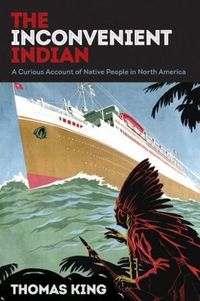
This chatty book of facts, opinions and talking points is a modern look at the native peoples of North America and how they have been, and are, treated by the Americans and Canadians. THE INCONVENIENT INDIAN stopped invading settlers and exploiters of mineral wealth from taking all they wanted, and became a magnified foe, to the extent that a plaque still stands in Almo, Idaho, to mark a most horrible Indian massacre which never occurred. The battle at Little Big Horn did occur, but by and large the native people received far worse treatment than they gave.
Thomas King, a Cherokee, takes a look at history without calling this a history book; no footnotes, he tells us. King points out that Canada largely fought with the Metis, who were part Indian and part English or French. He goes on to look at portrayals in literature and art, including stamps and currency; at Wild West shows where at least the Indian performers were paid and fed, and got to travel rather than sit on a reservation.
Then of course, there came Hollywood with its many westerns. Will Rogers, a Cherokee, is one of only two Natives to get stars on the Walk of Fame. There are more cartoon characters and dogs honoured on that Walk. Rogers never played an Indian role, but the other man so honoured was Jay Silverheels, whose most famous role was Tonto. Taylor Lautner, recent star in the Twilight series, was initially a white actor playing a Quilute but then discovered that he had forbears who were Ottowa and Potawatomi. King is wry about the previous portrayal as bloodthirsty savages having changed to vampire-killing werewolves. Black actors have had many starring roles in the past few decades, and a few Oscars, but aside from Graham Greene in Dances with Wolves and Chief Dan George in Little Big Man (I know him better from The Outlaw Josey Wales, not mentioned by King), Natives have not received Academy nominations and largely pay minor typecast roles. Northern Exposure is seen as the best television series for portraying and casting Natives.
King then goes into a lengthy look at the history of commerce and killing between the races, the difficulty of gaining votes for Natives (when even Blacks and women could vote). The reader has to excuse his dwelling on negative situations; it's his family, after all. Today's Natives live modern lives informed by traditional values, he says, and he would be fascinated to know what will happen to them over the next five hundred years. This is a very informative book, with a slight but not unpleasant bias, and anyone interested in the background would enjoy it as dip-into reading, with a thorough read ideal for research on a project.
No excerpt available.







 © 2003-2026