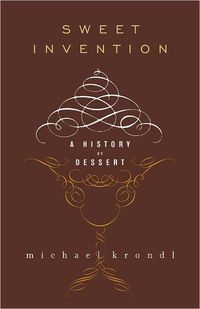
Make sure you have a macaroon or a cupcake handy before you crack the cover of SWEET INVENTION: A HISTORY OF DESSERT. You're going to be hungry for a taste of something sweet before you get through the introduction.
Krondl sees dessert in terms of music and often includes musical comparisons for the way a specific dessert "feels." This thoroughly researched book paints sweeping word pictures that describe not only tastes, but the people responsible for creating them. Within the book's pages, you meet the Sacher and the Linzer who gave their name to the respective tarts, and their predecessors back through history. Krondl gives us overviews of trends, but more often focuses in on an individual, and how that individual contributed to the history of "dessert" which he only loosely defines.
Throughout the text, we seem to be chasing the idea that dessert should be dessert, as many of the cultures discussed in the first part of the book present courses together buffet style, or serve sweet and savory courses without a sense that dessert should come last -- or in some cases, present entire banquets made up of course after course of sweets.
Krondl states at the outset that he will not cover dessert in every country in the world. Rather, the story he traces is of cane sugar, from boiled jiggery in India to the sweat of slaves on Caribbean sugar plantations, to the cheap sugar that allowed the glut of manufactured sweets into the American marketplaces.
Krondl uses primary sources, such as the journals of Indian kings and British visitors, to paint a picture of the grandeur and reverence with which milk, butter, and sugar were treated in India before taking us through the lands of Baklava and into Europe. He also interviews contemporary confectioners and pastry chefs across Europe, giving the narrative a feel of author-as-participant as well as expert.
A single recipe is included at the end of each chapter. Because of the historical nature of the recipes, this book would serve an excellent choice for a book group. Of course, it is also full of fascinating tidbits for the lone reader to share with friends and family.
No excerpt available.










 © 2003-2026