The trees in front of the houses around the Lindwood Court cul-de-sac all have bright white bows on them. They exude a festive mood and show purity, but they are there to temper the sharpness of the news that one of the residents has received. Paisley Lamm has pancreatic cancer that has metastasized to her liver. Could anything be worse?
Paisley is a lighthearted, cheerful, upbeat kind of person. Everyone likes her. She's very pretty and so nice. She's a great mom to her two young daughters and a supportive wife to her husband, Mason. She has helped several of the ladies on Lindwood Court through some very rough times in their lives. Now it is their time to support Paisley.
Andrea Chess, Iona Feld, Ginger Logan, and Julianne Havelock all have a special bond with Paisley. Paisley encouraged them during some dark days each of them were going through, and Paisley knows secrets of their past that each has shared with her. Each lady desires to do something for Paisley, but they are not sure just what. They feel this tragedy is not just happening to Paisley, but to all of them.
What bothers Paisley the most is that these dear friends are not coming to see her. Why is it so hard to go visit someone that you know is dying? Each woman has to come to grips personally with the reality of this dire situation before they can face Paisley.
As each friend eventually stops by to visit, Paisley makes them feel at ease with her, as she always does. Each woman reacts with different emotions: some leave with elation that Paisley is so upbeat, some feel dejected, some feel an overwhelming relief that the visit is over, all with disgust that Paisley is so ill. She asks each lady to promise her something as she whispers in their ear just what that something is. They all promise.
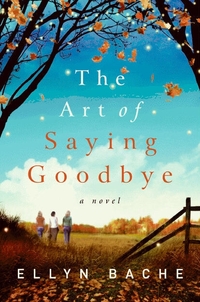
THE ART OF SAYING GOODBYE is a story of courage and friendship. Interspersed within the pages of Andrea's, Iona's, Ginger's and Julianne's personal stories, Paisley recalls good memories in her life. Each woman reminisces about the times that Paisley was their source of comfort and encouragement. This story is beautifully written and will inspire you to make a better effort to visit terminally ill friends while there is still time. This is a touching story you should not miss.
In a close-knit suburban development, four women find their
lives thrown into sharp relief as they tie white ribbons to
trees in front of their house—a gesture of support and
affection for a long-time neighbor who has fallen ill.
During the tense three months that follow, comforting their
friend also makes each of them remember how to celebrate the
joys and triumphs of love, family, and girlfriends. As the
days go by, these sisters in spirit grow closer, bonded by a
new sense of hope, courage, and strength that will help them
face any challenge, cherish every wonder, and, ultimately,
learn to let go. And in the afterglow of someone else’s
life, each will discover that her own is brighter and more
precious than she’d ever dreamed.
EXCERPT
Chapter 1
October 14
On this warm October night, if you turned into
Brightwood Trace beside the handsome brick entryway, and
followed the graceful curve of Brightwood Circle past the
three cul-de-sacs that branch off like fingers, you’d
notice even through the gathering fog that a white bow with
long streamers, one that might look good atop a large
wedding present, has been secured to a tree in front of
every house. Every house. This is not because of hostages
in some foreign country or a deeply-felt political cause.
It is to support one of their own. Paisley Lamm lives at
the top of Lindenwood Court, the highest point in the
development, and has to pass this way on every trip in or
out.
No one is sure who tied the first ribbon to a tree this
afternoon. Most people think it was Andrea Chess,
Paisley’s longtime friend, who knows her better than anyone
in Brightwood Trace except Paisley’s husband, Mason.
Andrea is the one with the mushroom-colored hair falling in
a bowl around her face, and those odd gray-green eyes that
seem somehow colorless, like slightly dirty water. You
wouldn’t imagine Andrea as Paisley’s best friend, but she
is. For twelve years they’ve shared secrets, gotten each
other through every crisis, given each other space. In
Andrea’s view, this has led to a special, dignified
friendship few women ever enjoy. Andrea loves Paisley like
a sister.
Most of the neighbors are much more ambivalent. Paisley
is pleasant to everyone, so affable and good-natured the
women find it hard to stay jealous even after their
husbands stare longingly at her at a party and it ruins
their night. They burn hot for a day or two, incensed that
a woman of forty-six should look so good. It’s unnatural.
Then on Monday or Tuesday they run into Paisley at the
supermarket or in the gym, where she offers a tomboyish
wave and spills benevolence onto them from her snappy blue
eyes. “Hey,” she trills, and “Hey,” they call back, and at
that moment their ill-will vanishes like smoke. There’s
something irresistible about Paisley. There’s something
that makes her seem the gracious hostess even in the
grocery store. The next time Paisley issues an invitation
for coffee or wine, the neighbor will say, yes, of course,
and forget until it’s too late the way her husband looked
at Paisley that time and probably will again.
Of course Iona Feld doesn’t feel this way. At sixty,
Iona is practically old enough to be Paisley’s mother –
maybe not quite – and hasn’t been much interested in men
since her husband died. . . . Iona isn’t jealous of
Paisley, but she enjoys her. At Paisley and Mason’s many
social gatherings, she watches with wry amusement the way
Paisley works a room. The more aware Paisley is of men
eyeing her, the more conscientious she is about
distributing her charms with judicious fairness, a little
for John, a little for Eddie, some for the women, too.
It’s almost an art form. . . .
This morning, Iona fought alarm, irritation, and an
actual lump in her throat while driving to A.C. Moore to
buy the biggest white bow she could find. . . . She was
furious at being sucked into this ordinary, unexotic
tragedy. She’s had her own tragedy. She doesn’t need
this. At home she tied the ribbons around the enormous
willow oak in her front yard, a tree she has always
despised, while its rough gray bark practically glowered
disapproval at having to wear a shiny white bow. . . .
By nightfall when the fog begins to gather, Iona is so
worked up that she’d like nothing better than to take one
of her long treks through the undeveloped field behind
Lindenwood Court, her usual way of burning off
energy. . . . She goes into her house instead, picks up the
newspaper, and fumes.
Up on Lindenwood Court, across the cul-de-sac from
Paisley’s house, Ginger Logan stands rigid at her bedroom
window, watching her twelve-year-old daughter, Rachel, slip
quietly out into the front yard. It’s all she can do not
to follow Rachel outside. They had their family discussion
about Paisley’s situation at dinner. Theoretically,
there’s nothing more to say. Ginger wishes Paisley well,
of course; they’ve been across-the-cul-de-sac neighbors for
more than nine years. But mostly, she’s concerned about
her children. Well, not so much about Max who at fifteen
wants only to drive. She worries more about her daughter.
Twelve is such an impressionable age. Lately Rachel has
become thoughtful and quiet, no longer a jabbering
child. Ginger wants to act before it’s too late. Do
something. Make sure her daughter is not scarred by this,
whatever happens. . . .
In the third house on Dogwood Terrace, Julianne Havelock
paces back and forth in her kitchen for such a long time
that her seventeen-year-old son, Toby – the only one of her
three sons who still lives at home – turns off the TV comes
in to ask if she’s all right.
“I’m fine. Just upset,” she says, though she hasn’t
been fine for days. More than anyone, Julianne knows
what’s going on. She knew how things would turn out even
while Paisley and Mason were waiting for the definitive
word. She knew from the beginning. And this . . . this
foreknowledge . . . is eerie. She might as well be a palm
reader or a gypsy with a crystal ball. Moving into the
front hallway, she squints out the window toward her maple
tree with its bow. She doesn’t see it. She is like
everyone else. It is not invisible just because of the
fog.
As they put up the bows today, Julianne thinks, everyone
in Brightwood Trace must have acted by rote. None of them
could possibly have thought about what they were doing.
The situation is, in the most literal sense, unthinkable.
They are in shock. At the beginning of this unknowable
journey, they sense – especially Julianne, Andrea, Ginger
and Iona – that this is happening not just to Paisley, but
to them all.











 © 2003-2026