|
On Top Shelf
|



Exclusive Marketing Opportunities for Authors
Curious about how Fresh Access helps authors gain more visibility and connect with active readers?
Discover premium promotional opportunities, enhanced exposure, and author-focused services designed to help your books stand out.

|
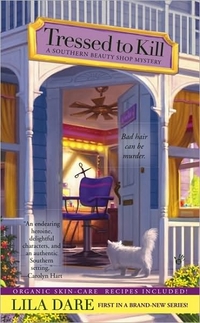
Purchase
Southern Beauty Shop #1 Mystery Woman Sleuth, Mystery Amateur Sleuth Excerpt of Tressed To Kill by Lila DareChapter One (Wednesday) A half-moon curl of platinum hair sprang from my scissors to join the growing pile on the floor. "Don’t take too much off, Grace," Vonda Jamison cautioned, craning her neck to check my progress. I’d been cutting her hair since we were in high school--you’d think she’d trust me by now. "Sit still." I tapped her head with my comb. Snip, snip. More curls drifted down. "You said you wanted it short." "Short, not shorn." She slouched back against the black leatherette chair. "Maybe I should go red." I swiveled the chair so she faced me instead of the mirror. The usual salon noises--customers chatting, water running in the shampoo basin, the phone ringing--washed around us but I tuned them out from long practice. "How’s Ricky?" I asked. When Von started talking about changing her hair color, it usually meant she and Ricky were on the outs. Her huge sigh was all the answer I needed. After fifteen years of best-friend-hood--we’d met as high school sophomores--we were pretty good at reading each other’s eye rolls, shrugs and sighs. "Over again?" "Over forever." Not likely. Vonda and Ricky Warren had been on-again-off-again as long as I’d known her. One particularly long stretch of "on" had resulted in a six-year marriage, twice as long as my ill-fated attempt at matrimony. When they divorced, I thought the "off" might be permanent, but they’d hooked up again before they’d paid off the lawyers’ fees. So I laughed, earning myself a glare. I deliberately changed the subject. "Are you going to the meeting tonight?" "Absolutely. Constance DuBois and her crowd are primed to snag all the funding for their ‘Preserve the Rothmere Antebellum Mansion’ initiative. PRAM." She wrinkled her nose. "How can people vote to pay for historically accurate nineteenth-century wallpaper, rather than new PCs for the schools? I swear, RJ’s using the computer equivalent of an abacus at Jefferson Davis Elementary. I’m going to make damned sure the vote goes in favor of funding the school’s technology center." Nothing got Vonda riled up faster than issues involving her eight- year-old, Richard James Warren the Fourth. I agreed with her that the school needed to update its technology, but I also knew historical homes like the Rothmere mansion brought a lot of tourists to St. Elizabeth, Georgia. And tourists meant money for local businesses like my mom’s salon, my place of employment. Choosing not to disagree with Von, I started to texturize the hair on her crown. "And what about the Morestuf Mart? Do you think we should approve that at the Town Hall Meeting?" "Hell, no." Vonda’s answer was swift and sure. "A big box store like that will eat into the profits of the downtown shops and places like Violetta’s." Her gesture took in the whole salon. "The historic district is the primary reason tourists come to St. Elizabeth. They can get Morestufs and Home Fix-Its and what-have-you back in Detroit or Philly or Kalamazoo--they come to St. Elizabeth for our charm and quaintness and Southern hospitality." She let her voice lapse into an exaggerated drawl. "Right, sugah?" "Right," I agreed, laughing. Vonda and Ricky owned a bed and breakfast on Peachtree Street and tourists were their lifeblood, as they were for most of the town since the paper mill shut down about ten years back. Pulling out my hair dryer, I cut off further conversation as I finished Vonda’s hair. "There." I turned the chair so she could see. "Grace, honey, you’re a genius." She beamed at her reflection. Wispy bangs hung down slightly over her brown eyes, giving her gamine face with its pointy chin a mysterious look. She looked great, if I did say so myself. "You’re just figuring that out?" I returned her exuberant hug and walked her to the door. "See you at the meeting tonight?" she asked, slipping on Jackie O sunglasses. "Wouldn’t miss it," I assured her. And neither would anyone else in town, I thought as she left, surveying the bustle in the salon. Normally, Wednesday afternoons were a bit slow, but the salon, the front half of my mom’s Victorian home, was packed. Mom, the Violetta the shop is named for, was doing a cut at her station near the front windows with the blinds lowered to cut the glare. Stella Michaelson, our manicurist, tackled two manicures at a time in the Nail Nook, an alcove behind the register, with her white Persian, Beauty, curled on a cushion at her feet. Althea Jenkins, my mom’s best friend and our part time aesthetician, waxed and tinted brows in the small room that used to be the formal parlor but which my mom had co-opted for the salon when she decided Violetta’s should offer spa services. Rachel Whitley, a high-schooler and aspiring beautician, shampooed our clients in the sink of the former powder room. We’d removed all the walls (and the toilet) and replaced some of them with waist-high barriers of glass bricks and it really opened the place up. In addition to our regular clientele, I noticed several of what I called the haute ton--a term for high society women I stole from my favorite Georgette Heyer Regencies--waiting for trims and mani-pedis. Not only was the Town Hall meeting an important budget forum, it was this week’s best opportunity to be photographed for the St. Elizabeth Gazette, our weekly newspaper more concerned with society events and the results of local gardening contests than the Iraq war or Wall Street projections. And that wasn’t a bad thing. Living in Atlanta with Hank, I’d endured enough stories of child abuse, gang violence, political skullduggery and genocide to last me a lifetime. The upbeat stories in the Gazette exactly suited my current mood. Lucy Mortimer, the curator of the Rothmere mansion and museum, was my next client and Rachel was just finishing up her shampoo. Rachel gave me a "two minutes" signal and I got a diet root beer from the small fridge we kept behind the counter and relaxed for a moment, enjoying the way the sun slanted through the wooden blinds and striped the broad pine floorboards. I tuned in to the conversation Mom was having with the teenage client in her chair. My mother, Violetta Terhune, leaned in over the girl’s shoulder. The violet tunic Mom wore contrasted nicely with her gray-white hair and her still lovely complexion, softened with a few wrinkles. Her blue eyes, framed by rimless glasses, smiled into the girl’s eyes in the mirror, like they shared a secret. Her soft bosom and twenty extra pounds made her look sweet and accommodating and motherly, but I’d seen that determined smile on her face more times than I could count when I was a teenager. Come to think of it, I still saw it on occasion. "Now, Mindy-honey, you know your mama’s not going to like it if you come home with your beautiful hair in a mohawk"--she stroked the girl’s bright head--"and magenta stripes." Mindy started to protest, but Mom over-rode her with, "Let me show you what I think would look just darling on you. I saw it on that actress, you know, the one in that movie about teenage vampires living in Dallas--such twaddle!--and you’re way cuter than she is." And she began snipping at the girl’s hair, talking all the while. Mindy’s face went from rebellious to resigned to tentatively pleased as I watched. And
that, I thought, suppressing a smile, summed up both the
delights and
the irritations of living in a small Southern town.
Everybody
knew everybody which created a warm sense of community. On
the
other hand, nothing was private and everybody thought they
ought to
have a say in your life which annoyed the heck out of me.
Slotting
the soda can into the recycle bin--my idea--I returned to
my station,
stopping to tell Mindy she looked fabulous and earning a
smile of approval
from my mom. I was finishing up Lucy’s blow-out when the front door banged open, jingling the bells and clattering the blinds. A man entered, dressed in full Civil War regalia. Confederate gray, of course, complete with a sword. That might have seemed strange or out of place in most salons, but Walter Highsmith owned the Civil War memorabilia shop two storefronts down from Violetta’s and he stopped in frequently. I’d long suspected he was sweet on my mom, but as far as I knew their relationship had never progressed beyond dinners, conversation and friendship. A short, plump man with a full goatee and a mustache that he waxed into rigid loops, Walter was, I thought, a bit barmy on the whole Civil War thing. He participated in re-enactments and came running over to tell Mom whenever he acquired a particularly interesting piece of memorabilia. Today, though, his chubby cheeks were flushed an angry red and he was almost sputtering as he sought out my mother. "Hello, Walter," she greeted him, putting her combs into a jar of blue germicide. "Do you know what this is, Miss Violetta?" he asked, flapping an envelope. "It’s an eviction notice. That . . . that woman is throwing me out at the end of the month. Right as tourist season starts!" The ends of his mustache quivered. "Oh, no," Mom said. "Why would she do that?" I knew the "she" my mom referred to was Constance DuBois, owner of several properties on the downtown square, including the building Walter rented for Confederate Artefacts. It originally housed the DuBois Bank and Trust which had re-located to a bigger building on the west side of town in the mid-1980s. "I’ve been there nineteen years, Miss Violetta. Nineteen years!" He stopped to take a deep breath. "Never have I been late with the rent. And now she evicts me without so much as the courtesy of a conversation, just because she has a friend--a Yankee from New York--who wants to open a scrap-booking shop. Frilly ribbons and precious papers and furbelows. Fah!" He threw up his hands and the letter wafted to the floor. He stamped on it. Then he pulled the sword from the scabbard at his side and ran the envelope through. "I’m not going to stand for it! She can’t do this." "Calm down, Walter," Mom said. All eyes in the shop were on the furious Confederate colonel waving his sword around with the envelope impaled on the tip. Despite his fussy mannerisms and mid-nineteenth century diction, I sympathized with him. Losing his storefront on the square and relocating to some hole-in-the-wall tourists would never find would probably force him out of business. The door opened again. A woman entered, talking non-stop into the cell phone glued to her ear. Uh-oh. Constance DuBois herself, grande dame of St. Elizabeth society; former Peach Festival Princess; president or former-president of the Junior League, the PTA, the Historical Preservation Society, and Save Our Shoreline; chairwoman of the Seafarer’s Spring Festival committee and PRAM; and evictor of Walter Highsmith. She sat on the boards of more local businesses than I could count, including her deceased husband’s bank, now run by her son. I hadn’t seen her since returning to St. Elizabeth from Atlanta four months ago but a quick glance told me she hadn’t changed. Same champagne-colored page boy cut, same prominent cheekbones, same sleek body garbed in designer resort wear. Now sixty, my mom’s age, she could probably still fit into the debutante dress she wore at eighteen. Lucy Mortimer stiffened in my chair and I looked at her curiously. "Later. I said later!" Constance DuBois snapped into the cell phone before closing it. She greeted my mom with a smile that hardly moved the corners of her mouth and didn’t touch her eyes. Botox. "You!" Walter said, his eyes bugging. "What is the meaning of this?" He flourished the sword in her face. The envelope jarred loose and drifted sadly to the floor. "Which words didn’t you understand?" Constance asked, facing him. "Out. By. June." "You won’t get away with this." Excerpt from Tressed To Kill by Lila Dare |






|
| |||
|
||||
 © 2003-2026